
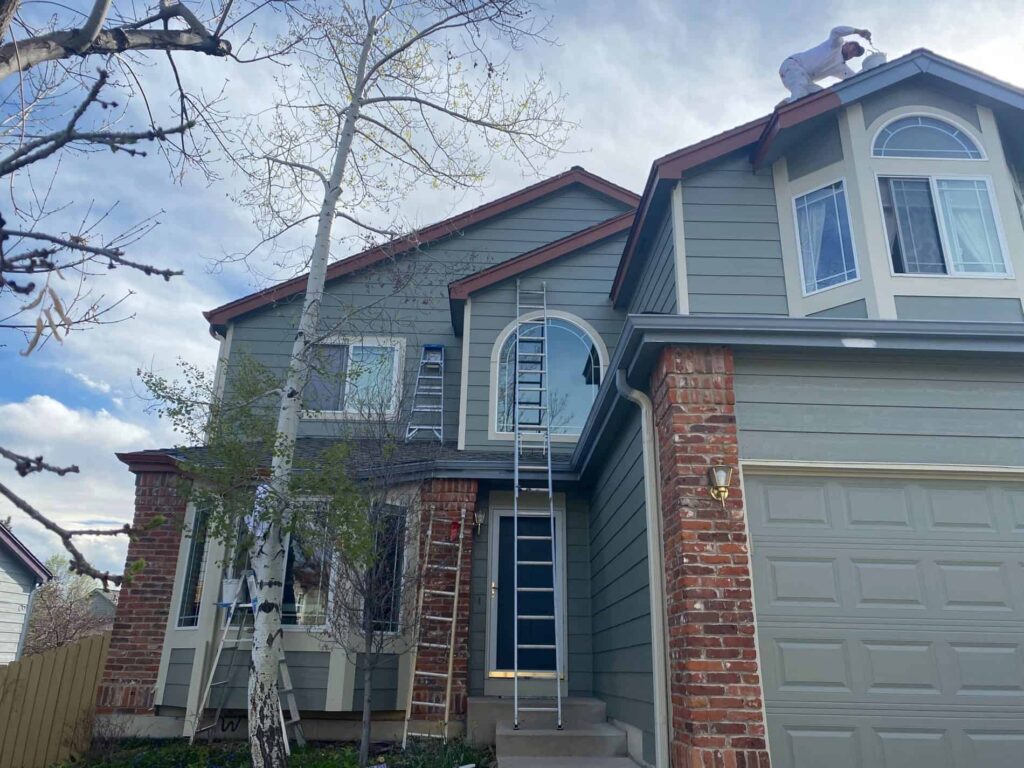
To paint a two story house exterior safely, you need the right ladder, proper setup, good weather conditions, and a clear plan before you ever touch a paintbrush. Two story homes reach between 18 and 25 feet in height, which puts you well above the danger zone for ladder falls. According to the Centers for Disease Control and Prevention (CDC), over 500,000 people are treated for ladder-related fall injuries in the United States every year, and more than 300 of those falls are fatal. This article covers everything you need to know: how to pick the right equipment, how to prep the surface, how to handle the weather, how much paint you need, and when it makes more sense to call a professional.
How Do You Safely Paint a Two Story House Exterior?
To safely paint a two story house exterior, you need a 28- to 32-foot extension ladder, a ladder stabilizer, non-slip footwear, and a helper on the ground at all times. Two story homes present real fall risks that one story homes do not. According to the World Health Organization, the United States leads the world in ladder-related deaths. Most of those deaths happen from falls of 10 feet or less, which means reaching the second floor puts you in extremely dangerous territory if you skip proper safety steps.
The CDC reports that in about 40% of ladder fall cases, the cause is a ladder sliding out at the base due to an incorrect setup angle. For every four feet of ladder height, the base needs to be one foot away from the wall. This is known as the 4:1 rule, and it is not optional. Set up your extension ladder at roughly a 75-degree angle every single time.
Homeowners in Lexington, South Carolina face an added challenge. The heat and humidity here can make surfaces slippery and affect how quickly paint dries. Wet or humid conditions make ladder rungs and painted surfaces more dangerous. Always check weather conditions before you climb.
What Equipment Do You Need to Paint a Two Story House Exterior?
The equipment you need to paint a two story house exterior includes an extension ladder rated for your weight plus tools, a ladder stabilizer or standoff, a tool belt or paint hook, non-slip work boots, safety glasses, and drop cloths. Do not try to carry a paint bucket up the ladder with you. According to OSHA, carrying objects in your hands while climbing is a major cause of painter falls. Use a tool belt or a paint hook that attaches to a ladder rung so both your hands stay free.
Your ladder needs to be in perfect working order before you use it. Inspect every rung for cracks, bent metal, loose bolts, and worn rubber feet. A self-employed painter in Massachusetts fell 14 feet from an extension ladder because the ladder had bent rungs, damaged side rails, and failed feet. That accident could have been prevented with a simple pre-use inspection.
A ladder stabilizer (also called a standoff) is one of the best investments you can make for this job. It mounts to the top of the ladder and pushes the ladder away from the wall, giving you safer access to soffits, eaves, and gutters without resting the ladder on the surface you are painting.
For larger areas and extended work at height, scaffolding is a safer alternative. If you will be working above 10 feet on scaffolding, the Occupational Safety and Health Administration (OSHA) requires guardrails. Scaffolding provides a stable platform and reduces the need to constantly move and re-set a ladder.
What Size Ladder Do You Need for a Two Story House?
The size ladder you need for a two story house is a 28- to 32-foot extension ladder. Two story homes typically stand between 18 and 25 feet tall. Your ladder needs to extend at least three feet above the roofline or the working surface, so a 28-foot ladder is the minimum. If your home has steep rooflines or dormers, a 32-foot ladder gives you more reach and safety margin. Make sure the ladder has a weight rating that includes your body weight plus tools and paint supplies. Most residential ladders are rated for 200 or 250 pounds. If you weigh 180 pounds and carry 20 pounds of tools, a 200-pound-rated ladder gives you zero safety margin. Choose a ladder rated for at least 300 pounds for this kind of work.
How Do You Prepare the Surface Before Painting a Two Story House Exterior?
To prepare the surface before painting a two story house exterior, you need to pressure wash the siding, scrape all loose and peeling paint, sand rough edges, caulk gaps around trim and windows, and prime bare wood before applying finish coats. Skipping prep is the number one cause of paint failure. Paint applied over dirty, chalky, or peeling surfaces will not bond properly and will start to peel again within one to two years.
Pressure washing should happen at least 24 to 48 hours before painting. This gives the surface time to dry completely. Wood siding should test at below 15% moisture content before you paint. If you paint over wet wood, moisture gets trapped under the coating and causes bubbling, blistering, and mildew growth. Many homes in Lexington and the surrounding Lake Murray area are exposed to high humidity, which means surfaces hold moisture longer than you might expect.
After washing, walk the entire perimeter and look for rotted wood, damaged caulk, and cracks in siding. Address any sheetrock or surface repairs before you prime. Paint covers color, not damage. If rot or cracks go unaddressed, they will continue to grow behind the new paint and cause bigger problems down the road.
Do You Need to Prime Before Painting a Two Story House Exterior?
Yes, you need to prime before painting a two story house exterior if you are painting bare wood, changing from a dark color to a light color, covering stains, or working over a surface that has never been painted. Primer improves adhesion, seals porous surfaces, and helps the finish coat last longer. According to Sherwin-Williams, one gallon of exterior primer covers roughly 200 to 300 square feet. Most exterior primers need to dry for at least four hours before you apply a finish coat. In South Carolina’s humidity, give primer extra drying time, especially on the shaded north side of the home where moisture lingers.
At What Temperature Should You Not Paint Exterior?
You should not paint the exterior of your home when temperatures are below 50 degrees Fahrenheit or above 85 degrees Fahrenheit. According to Benjamin Moore, the acceptable temperature range for exterior painting is between 35 degrees and 100 degrees Fahrenheit, but the optimal range is 60 to 85 degrees. Outside that range, paint cannot bond or cure properly.
In Lexington, SC and the Red Bank and Gilbert areas, summer afternoons regularly push past 90 degrees. When surfaces get that hot, paint dries too fast. It flashes before the binder can spread evenly, leaving brush marks, lap marks, and blistering. Consumer Reports recommends a simple test: if you cannot hold your palm flat against the exterior wall for more than a few seconds because it is too hot, do not paint it.
Humidity matters just as much as temperature. Experts recommend painting when relative humidity is between 40% and 70%. According to a local painting resource specific to Lake Murray, South Carolina, the ideal seasons for exterior painting in this region are spring and fall, when temperatures run between 60 and 75 degrees and humidity is more manageable. Summer in the Midlands can push humidity past 80%, which slows drying and causes streaking.
The table below shows the key weather conditions for safe and successful exterior painting.
| Condition | Ideal Range | What Happens Outside Range |
|---|---|---|
| Air Temperature | 50°F to 85°F | Paint fails to bond or dries too fast |
| Surface Temperature | 50°F to 90°F | Blistering, flashing, poor adhesion |
| Relative Humidity | 40% to 70% | Slow drying, streaking, mildew risk |
| Wind Speed | Low (under 15 mph) | Ladder instability, fast drying, debris in paint |
| Rain Window After Painting | 4 to 8 hours minimum | Paint washes off or bubbles |
Sources: Benjamin Moore Technical Guidelines; Hirshfield’s Painting Guide; Family Handyman Exterior Painting Temperature Reference; Anderson Painting NC Weather Guide
Is October Too Late to Paint Outside?
October is not too late to paint outside in South Carolina. In Lexington and the Columbia metro area, October temperatures regularly stay in the 60s and low 70s during the day, which falls within the ideal painting range. The key is to watch the nightly lows. If overnight temperatures drop below 35 degrees Fahrenheit before the paint has fully cured, the finish can crack or peel. According to Hirshfield’s Painting, paint needs to stay above 35 degrees for at least 36 hours after application to cure properly. In the Midlands of South Carolina, October is actually one of the best months to paint an exterior because the summer heat has broken and the humidity has dropped.
How Many Days Does Exterior Paint Need to Dry Before Rain?
Exterior paint needs at least 4 to 8 hours to dry before rain. Most exterior latex paints are touch-dry in two to four hours but need a full rain-free window to resist wash-off. According to Family Handyman, if a heavy downpour hits a fresh exterior paint job that has not fully cured, you may need to redo sections entirely because rainwater can wash away the paint film and cause spotting. Always check the 24-hour forecast before painting and give yourself a full dry-weather window after the last coat.
How Many Gallons of Paint for a Two Story House Exterior?
A two story house exterior typically requires 22 to 25 gallons of paint for the body, siding, soffits, and overhangs, plus 3 to 5 gallons for trim, gutters, and window frames. This estimate is based on a standard two story home of approximately 2,500 square feet. Most exterior paints cover between 250 and 400 square feet per gallon, depending on the surface texture and porosity.
According to Behr, one gallon of exterior paint covers between 250 and 400 square feet with one coat. Rough surfaces like stucco or older wood siding absorb more paint and may only get you 200 to 250 square feet per gallon. Smooth surfaces like vinyl siding or fiber cement can stretch a gallon closer to 400 square feet. Always plan for two coats, especially when changing colors. Two coats on a 2,500 square foot home means you need roughly 13 to 20 gallons of body paint depending on coverage rates and surface texture.
If your Lexington area home has a large covered porch or deck area attached, factor those into your estimate separately. Porch painting involves different surfaces and finishes than standard siding and should be calculated on its own.
Is Two Coats of Exterior Paint Necessary?
Yes, two coats of exterior paint are necessary in most situations. One coat of paint rarely provides enough film thickness to protect siding from UV damage, moisture, and temperature swings. According to Sherwin-Williams, a gallon of paint covers 350 to 400 square feet per coat. With only one coat, the coverage is thin and the color may appear uneven or translucent, especially when going from a dark color to a lighter one. Two coats give you full hide, better color depth, and a finish that lasts significantly longer. Most professional painters apply two finish coats after primer for exterior work.
What Is the Correct Way to Paint a Two Story House Exterior?
The correct way to paint a two story house exterior is to work from the top down, painting soffits and eaves first, then the upper body of the siding, then trim and windows, and saving the ground-level areas for last. Working top-down prevents drips from landing on freshly painted lower sections. Always keep a wet edge as you go so you do not get lap marks between strokes.
Start on the shaded side of the house. On hot days in Lexington and Chapin, direct sunlight bakes paint onto siding before you can spread it evenly. Many professional painters call this “chasing the shade.” They start on the north or east side in the morning and work around the home as the sun moves. This keeps surface temperatures in the right range and prevents flash-drying.
Use a brush for cutting in around trim, windows, and corners. Use a roller for large flat siding sections. An airless paint sprayer can speed up the job significantly but requires more masking and setup to protect windows, trim, landscaping, and adjacent surfaces. Sprayers also require extra safety awareness at heights.
Keeping your work area clear is critical when working at two story height. Drop cloths should be taped down at the edges to prevent tripping. Remove all garden tools, hoses, and furniture from the base of the ladder path. A fall caused by tripping on a hose or bucket on the ground is just as dangerous as a fall from the ladder itself.
How Do You Reach the Top of a Two Story House to Paint?
To reach the top of a two story house to paint, you use a 28- to 32-foot extension ladder with a stabilizer attached, or you rent sectional scaffolding for long runs of siding. Never stand on the top three rungs of an extension ladder. That is not a guideline; it is a hard rule. The top three rungs of an extension ladder have no structural support from the wall and the ladder can tip backward without warning. Position the ladder so your waist or chest is even with the highest point you need to reach. If you need to go higher, move the ladder rather than leaning or stretching.
Many homeowners in the Gilbert and Red Bank areas have two story homes with steep-pitch rooflines that make standard ladder placement tricky. A ladder standoff helps in these situations by bracing against the fascia and keeping the ladder stable even when the roofline forces an awkward angle.
How Do You Paint High Gables on a Two Story House?
To paint high gables on a two story house, you position the extension ladder directly below the gable peak and use a roller with an extension pole to reach the upper triangle of siding without overreaching from the ladder. Gable peaks are one of the most dangerous areas to paint because the narrow triangular shape forces you to lean sideways as you reach upward. Never lean your body past the side rails of the ladder to reach a gable corner. Move the ladder as many times as needed to keep your body centered between the rails at all times. The InterNACHI standard for safe ladder use states clearly that a climber must maintain their belt buckle between the side rails throughout the entire climb.
Homes with high gabled dormers or complex rooflines may benefit most from professional exterior painting. The risk of falls increases sharply when the surface geometry forces multiple repositions at heights above 20 feet.
Is It Cheaper to DIY or Hire Painters for a Two Story House Exterior?
Hiring professional painters for a two story house exterior typically delivers better long-term value than a DIY approach, even if the upfront labor cost is higher. Here is why. When you DIY, you still pay for paint, primer, rollers, brushes, drop cloths, ladder rental or purchase, caulk, and prep supplies. Then you spend multiple weekends doing work that carries real fall risk. According to the National Safety Council, over 50,000 ladder-related injuries require emergency room treatment in the United States every year. Most ladder injuries happen to people doing exactly this kind of home improvement work.
Professional painters bring their own equipment, carry liability insurance, work faster, and typically apply higher quality prep and coatings than DIY projects achieve. According to a HomeLight survey of over 900 real estate agents, 66% of agents recommend exterior painting before listing a home for sale. A professional paint job that is done correctly increases home value by 2% to 5%, according to Consumer Reports. On a $350,000 home in the Lexington, SC market, that is a $7,000 to $17,500 value increase from a single project.
For full exterior painting services from a licensed and insured team that knows this area, working with a local professional eliminates the safety risk entirely and delivers results that last.
What Are the Most Common Painting Mistakes?
The most common painting mistakes are skipping surface prep, painting in the wrong weather, not using primer, overloading the brush, and failing to maintain a wet edge. These mistakes show up fast. Skipping prep leads to peeling within a year. Painting in high heat leads to brush marks and blistering. Skipping primer on bare wood leads to bleed-through and uneven color. Overloading a brush or roller leads to drips and runs that are very visible on siding. Losing the wet edge leads to lap marks that you can see across the full face of the wall.
Another common mistake specific to two story work is overreaching. Reaching too far to the left or right to avoid repositioning the ladder is how most painter falls happen. According to OSHA fall prevention data, overreaching accounts for a significant portion of painting accidents. It takes an extra two minutes to move the ladder. That two minutes is worth it every time.
How to Spot a Bad Painter
A bad painter skips prep, does not use primer, applies only one thin coat, leaves brush marks and roller lines in the finish, does not caulk gaps around trim and windows before painting, and does not protect landscaping and windows during the job. Other red flags include no proof of insurance, no written contract, and pressure to pay the full amount upfront before work begins. A professional painting company should be licensed, bonded, and insured. They should provide a written scope of work, a clear timeline, and references from past jobs in your area.
What Exterior Paint Lasts 25 Years?
Exterior paints that can last 25 years or more are high-quality 100% acrylic latex formulas from brands like Sherwin-Williams Duration, Benjamin Moore Aura, and BEHR Premium Plus Ultra. These paints use advanced acrylic resin technology that resists fading, cracking, and peeling far better than standard grade products. According to Benjamin Moore, their Aura exterior line is engineered for superior adhesion and long-term color retention. Sherwin-Williams similarly markets Duration as a 25-year product under normal conditions.
The actual lifespan of exterior paint depends on surface prep quality, climate conditions, and the type of siding. In South Carolina’s climate, which brings hot summers, high humidity, heavy rain, and UV intensity, even premium paint should be inspected every 5 to 7 years. Homes near Lake Murray with significant shade or moisture exposure may need attention sooner. Annual inspection for cracking, chalking, or peeling gives you the chance to spot trouble before it becomes a full repaint.
Choosing premium paint also affects how well the decks, docks, and fences around your home hold up. Outdoor wood surfaces need coatings specifically designed for ground contact and weather exposure, which is a different product category than standard exterior siding paint.
What Is the Longest Lasting Exterior Paint Brand?
The longest lasting exterior paint brands are Sherwin-Williams Duration, Benjamin Moore Aura Exterior, and BEHR Marquee Exterior. All three are 100% acrylic formulas designed for 15 to 25 years of performance under normal conditions. Sherwin-Williams Duration and Benjamin Moore Aura consistently rank at the top in independent testing for adhesion, fade resistance, and film integrity. The key difference between these premium products and budget options is the concentration of acrylic resin and pigment load. Higher quality paint covers better, bonds stronger, and lasts longer even in demanding climates like the South Carolina Midlands.
What Happens If It Rains the Day After You Paint Your House?
If it rains the day after you paint your house, the outcome depends on whether the paint had enough time to cure before the rain hit. Most exterior latex paints need at least 4 to 8 hours to resist light rain. If it has been less than 4 hours since the final coat went on, rain can wash the paint away, cause streaking, or create bubbles. According to Anderson Painting, heavy rain on a fresh exterior paint job that has not cured may require you to strip and redo affected sections entirely. If the paint has had 8 or more hours to dry before a light rain, it will likely be fine. Always check the 48-hour forecast before starting an exterior painting project.
Does Painting Increase Home Value?
Yes, painting increases home value. According to Consumer Reports, a well-done exterior paint job increases a home’s value by 2% to 5%. On a $300,000 home, that is a $6,000 to $15,000 increase. The HomeLight survey of real estate agents reported an ROI of 51% to 55% for exterior painting. That means for every dollar you spend on exterior paint, you get roughly 50 cents back in increased home value, on top of keeping that dollar you spent. Combined interior and exterior painting can push the total ROI above 107%, making it one of the highest return home improvement projects available.
The National Association of Realtors reported in 2019 that 66% of real estate professionals agreed that exterior painting should be done before listing a home for sale. A fresh, clean paint job signals to buyers that the home has been maintained well. Peeling or faded paint does the opposite. It suggests deferred maintenance and often becomes a negotiation point that lowers the sale price.
Whether you are preparing to sell a home in the Lexington market or simply want to protect your investment, fresh exterior paint is one of the most financially sound upgrades available. For complete house painting results that hold up in the South Carolina climate, proper prep and professional-grade coatings make all the difference.
What Color Is Replacing Gray?
The color replacing gray for exterior homes is “greige,” a warm blend of gray and beige. According to Zillow’s color analysis research, the most attractive exterior color to current home buyers falls in the greige family. It reads as fresh and modern while still working with most landscaping styles and architectural types. Warm off-whites, soft taupes, and creamy neutrals are also gaining ground as replacements for the cooler blue-grays that dominated the market for the past decade. For trim and front doors, darker contrasting colors like black, charcoal, and navy continue to trend strongly and add perceived value. According to Zillow research, a dark front door can add an average of $1,514 or more to a home’s asking price.
What Color Makes a House Look Expensive?
Colors that make a house look expensive are soft white, warm greige, classic navy, and charcoal gray, especially when paired with crisp bright white trim. According to Zillow’s color research, homes with greige or warm neutral exteriors paired with dark contrasting accents consistently outperform homes with bold or dated color choices in buyer perception studies. A well-executed two-tone color scheme with a clean neutral body and rich dark trim communicates quality and attention to detail, which buyers associate with a well-maintained home.
Frequently Asked Questions
Can You Paint a Two Story House Exterior Yourself in Lexington, SC?
Yes, you can paint a two story house exterior yourself in Lexington, SC, but it carries significant safety risk and requires substantial time, equipment, and physical effort. According to the CDC, over 500,000 people are treated for ladder-related fall injuries each year in the United States, and most of those injuries happen during home improvement work, not on the job. Homeowners in Lexington, Red Bank, and the Gilbert area who attempt two story exterior painting without proper equipment or experience are at real risk of serious injury. If you proceed with DIY, never work alone, always use a proper extension ladder with a stabilizer, and follow the 4:1 angle rule for every setup.
What Is the Best Time of Year to Paint a House Exterior in Lexington, SC?
The best time of year to paint a house exterior in Lexington, SC is spring (March through May) and fall (September through November). These seasons provide the moderate temperatures between 60 and 80 degrees Fahrenheit and lower humidity levels that exterior paint needs to bond and cure properly. According to a Lake Murray, SC painting resource, summer heat above 85 degrees in the Midlands causes paint to flash-dry too fast, while winter nights can drop below the curing threshold. Spring and fall give the best conditions for a long-lasting finish in South Carolina’s climate.
How Long Does It Take to Paint a Two Story House Exterior?
It takes a professional crew 3 to 5 days to paint a standard two story house exterior, including prep, priming, and two finish coats. DIY painters working alone or with one helper may take 1 to 3 weekends depending on the size of the home, the amount of prep work needed, and weather cooperation. Larger homes in the Lexington and Chapin area with complex rooflines, multiple gables, or significant surface damage will take longer. Rushing the job to save time is one of the most common causes of poor results.
Do Painters in Lexington, SC Paint Two Story Houses?
Yes, professional painters in Lexington, SC regularly paint two story houses. Local painting companies serving the Lexington, Red Bank, and Lake Murray area have the equipment, insurance, and experience to handle two story exterior work safely and efficiently. A licensed and insured painting company eliminates your personal liability in the event of a job site injury and delivers results that DIY efforts cannot match. According to a HomeLight survey, 66% of real estate agents recommend professional exterior painting before listing a home for sale.
How Often Should You Repaint a House Exterior in South Carolina?
In South Carolina, you should repaint a house exterior every 5 to 10 years, depending on the paint quality, surface material, and sun exposure. Homes with south-facing walls in direct sunlight around the Lexington, SC area may show fading and chalking in as few as 5 to 7 years. Premium 100% acrylic latex paints can extend that cycle significantly. Annual inspections for cracking, bubbling, or peeling give you early warning before minor problems become full failures. Areas near Lake Murray with heavy tree coverage and shade may experience mildew growth that requires earlier attention.
What Does a Two Story Exterior Painting Project Include?
A two story exterior painting project includes pressure washing, full surface prep and scraping, caulking around trim and windows, priming bare surfaces, and two finish coats on siding, soffits, fascia, trim, and doors. Some projects also include drywall repair and painting for damaged sections of exterior wall material. The scope should be clearly defined in a written contract before work begins. Ask your painter whether porches, shutters, and garage doors are included or priced separately.
Is Hiring a Professional Painter Worth It for a Two Story House in the Columbia Area?
Yes, hiring a professional painter is worth it for a two story house in the Columbia and Lexington area. The combination of safety risk, equipment cost, time investment, and quality gap makes professional painting the smarter financial decision for most homeowners. According to Consumer Reports, a well-done exterior paint job increases home value by 2% to 5%. A professional crew delivers that return on investment far more reliably than a DIY project. Licensed, bonded, and insured painters also protect you from financial liability if anything goes wrong on your property during the job.
Final Thoughts
Painting a two story house exterior safely comes down to four things: the right equipment, proper surface prep, the right weather window, and realistic expectations about height and risk. According to the CDC and the World Health Organization, ladder falls are one of the most common causes of serious injury and death in the United States, and most of those accidents happen during exactly the kind of work described in this article. If you take on a two story exterior paint job yourself, use a 28- to 32-foot extension ladder with a stabilizer, follow the 4:1 base angle rule every time, never stand on the top three rungs, and always have a helper on the ground. Choose a day between 60 and 85 degrees Fahrenheit with humidity below 70% and no rain in the forecast for at least 8 hours.
If you live in Lexington, South Carolina, or the surrounding Red Bank, Gilbert, or Lake Murray area, the team at Soda City Painting is ready to handle your two story exterior from start to finish. BBB accredited, licensed, and insured, they bring professional-grade prep, premium coatings, and the right equipment to every job. Contact them today for a free estimate and see what a properly done exterior paint job can do for your home’s curb appeal and value. Reach out to the team at Soda City Painting’s exterior painting service and take the first step toward a finish that protects and beautifies your home for years to come.