
To paint a front door without removing it, and the results can look just as clean and professional as taking the door off entirely. The key steps are cleaning the door, sanding lightly, taping off the hardware and glass, painting in the right order from panels outward, and applying two thin coats. This guide covers exactly how to do it, which paint to use, the best colors, what mistakes to avoid, and how much the job costs when you hire a professional in the Lexington, SC area.
How to Paint a Front Door Without Removing It
To paint a front door without removing it, prop it fully open, tape off the hinges and hardware, clean and sand the surface, and paint in a specific order starting with the recessed panel details and finishing with the large flat sections. Working top to bottom with thin coats and keeping a wet edge prevents drips and lap marks. The door stays secure the entire time and you can finish the job in a single morning.
According to The Family Handyman, painting a front door on its hinges works well as long as you use thin coats, stay alert to drips since you are working against gravity, and lay a drop cloth under the door to catch anything that runs. The finish quality difference between painting on hinges versus removing the door is minimal when the prep and technique are right. For homeowners across Lexington, SC, keeping the door on the hinges also means your home stays secure while you work, which matters during the warm months when insects and heat make an open doorway impractical for hours at a time.
Step 1: Pick the Right Day and Time
The right day and time to paint a front door without removing it is a mild, overcast morning with low humidity and no rain expected for at least 24 to 48 hours. According to Painting by the Penny, avoid painting in direct sunlight, in temperatures below 50 degrees or above 90 degrees Fahrenheit, or when humidity is very high. Direct sun bakes the paint dry too fast, leaving lap marks and brush strokes you cannot blend out. In Lexington, SC, the best painting windows are spring mornings from late March through May and fall mornings in September and October. Summer afternoons in the Midlands are the worst time, as heat and humidity both peak and work against you.
Step 2: Remove or Tape All Hardware
Remove the doorknob, deadbolt, knocker, kick plate, and house numbers before painting. Removing hardware completely gives you cleaner lines and is faster than trying to tape perfectly around curved or irregular shapes. If a piece cannot be removed, press painter’s tape firmly around it and use a putty knife or an exacto knife to cut the tape flush with the edge of the hardware. According to Home Painters Toronto, use your finger to smooth the tape along every edge and run an exacto knife along the hinge line to remove excess tape and get a clean, tight seal.
For hinges, a thin coat of car wax applied to the metal plate before taping gives you an extra layer of protection. Any paint that lands on the waxed hinge wipes right off and polishes the metal at the same time, according to painting pros at Ugly Duckling House.
Step 3: Clean the Door Completely
Clean the door completely before sanding or painting by scrubbing the entire surface with a mild soap and water solution or an all-purpose degreaser. Skin oils, dirt, pollen, and grime build up around the handle area and across the face of the door over time. Paint applied over any of that contamination bonds to the dirt instead of the door, which causes early peeling. According to The Family Handyman, use an old toothbrush to scrub out the tight recessed panel edges where dirt collects. Rinse the door and wipe it dry with a clean microfiber cloth before moving on.
To check whether the existing paint on your door is oil-based or latex, rub a small amount of rubbing alcohol on a hidden area with a cloth. If paint comes off, it is latex and you can paint right over it. If nothing comes off, it is oil-based and you must prime with an oil-based or shellac primer before applying latex paint on top, according to Practically Functional and House of Hawthornes.
Step 4: Sand the Surface
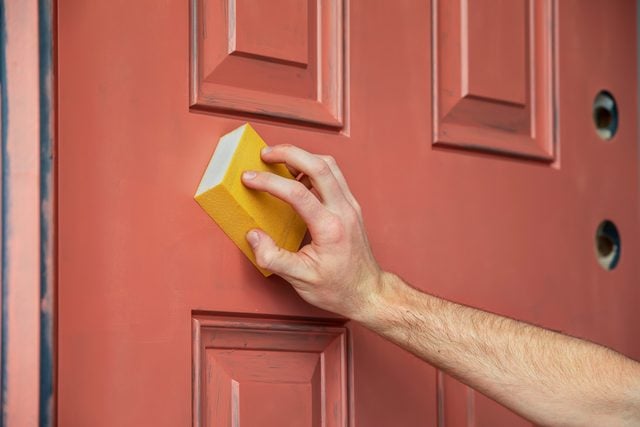
Sand the entire door surface with 120-grit sandpaper first to remove any peeling paint and smooth out imperfections, then follow with 220-grit to create a fine, even surface the new paint will grip. According to Painting by the Penny, sanding is what separates a paint job that stays put for years from one that starts chipping within a season. Fill any holes, dents, or cracks with exterior wood filler, let it dry fully, and sand smooth. After sanding, wipe the door down with a damp cloth and finish with a dry cheesecloth or tack cloth to remove all dust before applying any primer or paint.
Step 5: Prime If Needed
Prime the door if the existing paint is oil-based, if bare wood or metal is exposed, if the door is heavily stained, or if you are going from a very dark color to a significantly lighter one. According to Lowe’s, primer helps hide old pigment and reduces the number of topcoats needed for full coverage when making a dramatic color change. If the old paint is latex, firmly bonded, and you are staying in a similar color range, you can skip primer and go straight to the topcoat. Let primer dry fully before painting, always following the manufacturer’s recommended dry time on the label.
Step 6: Tape Windows, Glass, and the Frame
Apply painter’s tape around all glass panels, sidelights, and door frame edges before any paint goes on. Press the tape firmly into every corner with a putty knife. Lay a drop cloth flat on the floor directly beneath the door. For glass inserts, run the tape along the inside edge of the frame and smooth it with your finger for a seal that prevents paint from bleeding onto the glass. Sloppy taping means paint on your glass, trim, and brick, which takes far longer to clean up than the time saved by rushing this step.
Step 7: Paint in the Correct Order
Paint a front door in the correct order by starting with the recessed panel edges and molding details at the top and working down, then painting the flat face of each panel, then the vertical center strip, then the horizontal rails, and finishing with the two outer vertical edges. This order prevents the most common beginner mistake, which is painting a large flat section and then brushing over the wet edge when you go back to do the details. According to Ugly Duckling House and Pine and Poplar, always follow the direction of the wood grain when brushing. This hides brush marks and gives the door a clean, even look. Use an angled brush for all the tight detail areas and switch to a foam roller for the large flat sections.
Pro Tip: Keep a wet edge at all times. Never stop in the middle of a flat section and walk away. If the leading edge dries before you blend the next stroke into it, a visible lap line forms in the cured paint that no second coat will cover.
Step 8: Apply a Second Coat
Apply a second coat of paint after the first coat is completely dry. Most front doors need two to three coats for full, even coverage with no bleed-through from the old color. According to Painting by the Penny, thick coats are more likely to cause drips, uneven sheen, and brush marks than two thinner coats applied correctly. Lightly sand with a 320-grit sanding sponge after the first coat dries to knock down any texture, wipe clean, and apply the second coat the same way you applied the first, top to bottom in thin, even passes.
Step 9: Pull the Tape and Reinstall Hardware
Pull the painter’s tape while the paint is still slightly damp, not after it has dried hard. Pulling tape off cured paint tears the edge and leaves a ragged line that requires touching up. Remove the tape at a 45-degree angle slowly and steadily. Let the door dry for at least 24 hours before closing it fully. Closing a freshly painted door too soon causes the paint to stick to the door frame and peel off when the door is next opened.
Should I Take My Front Door Off to Paint It?
No, you should not take your front door off to paint it in most cases. Painting it on the hinges is faster, keeps your home secure the whole time, and produces results that look just as good as painting a removed door when the prep and technique are correct. According to The Family Handyman, the best way to paint a door is to take it off its hinges for the flattest possible finish, but painting on hinges works very well for most homeowners and is the practical choice for anyone who cannot leave the home open and unsecured during the painting process. For most homes in Lexington, Red Bank, and across the Lake Murray area, painting on the hinges is the right call.
Is It Better to Brush or Roll Paint on a Door?
It is better to use both a brush and a roller when painting a front door. Use a brush for the recessed panel edges, molding details, and any tight corners where a roller cannot reach cleanly. Use a foam roller for the large flat sections of the door because it leaves a smoother finish with far fewer visible texture marks than a brush alone on flat surfaces. According to The Family Handyman, starting with an angled paintbrush on the recessed details and then switching to a paint roller for the large flat areas gives the best overall result when painting a door on its hinges.
A paint sprayer gives the smoothest finish of all three methods and is what professional painters use on front doors. Spraying produces a near-factory coat with no brush texture at all, but requires more masking time to protect surrounding surfaces. For a DIY job without a sprayer, the brush-and-roller method is the most practical choice and delivers clean, professional-looking results.
What Kind of Paint Will Stick to a Front Door?
The kind of paint that will stick to a front door is 100% acrylic exterior paint in a semi-gloss or gloss finish. Acrylic paint bonds firmly to wood, steel, and fiberglass, handles temperature swings without cracking, and resists humidity, mildew, and UV fading. Semi-gloss and gloss finishes are more durable and easier to wipe clean than flat or satin finishes, making them the standard choice for exterior doors. According to Pine and Poplar, satin finish is also a solid choice because it is durable and easy to clean without looking too shiny.
Top brands for front door paint include Sherwin-Williams, Benjamin Moore, and Behr. Benjamin Moore’s Aura Grand Entrance line is formulated specifically for exterior doors and is popular with professional painters for its self-leveling properties, which minimize brush marks and produce a near-spray finish from a brush and roller. If adding Floetrol, a paint conditioner, to your topcoat, it helps the paint level out even further and eliminates visible brush strokes, according to Thrifty Decor Chick.
What Color Should You Not Paint Your Front Door?
The colors you should not paint your front door are gray, saturated blue, and olive green if selling your home matters to you. A 2023 Zillow study of over 4,700 prospective and recent home buyers found that gray front doors were associated with homes selling for roughly $3,365 less than similar homes with different door colors. Saturated blue and olive green led to lower sale prices by about $1,300 each and reduced the number of buyers willing to schedule an in-person tour, according to the same Zillow data.
Beyond resale, avoid colors that blend too closely into the siding color. A door that disappears visually into the exterior loses its power as a focal point and makes the whole front of the house look flat and uninviting. The front door should stand out from the siding and create contrast, not compete with it or disappear into it.
What Front Door Color Adds the Most Value?
The front door color that adds the most value is black. Zillow research shows a black front door can boost a home’s offer price by about $6,450 compared to the typical U.S. home value. Homes with black front doors were also more likely to be revisited by potential buyers for in-person tours, giving sellers a competitive edge. Black works with nearly every exterior color scheme, from white siding to brick, stucco, and gray, and signals a polished, well-maintained property.
Navy blue is the second-strongest value color. Zillow data cited by CertaPro Painters shows navy blue front doors raised home sale prices by approximately $1,500. Navy pairs cleanly with white, cream, and light gray exteriors and gives a home a refined, elevated appearance without being trendy. Homeowners across Lexington, SC preparing to list their homes often find that a freshly painted front door in black or navy is one of the highest-return investments they can make before going to market. According to survey data from Revive Real Estate, homes with strong curb appeal sell for an average of 7% more than comparable homes without it.
What Are the Three Paint Colors That Will Never Go Out of Style?
The three paint colors that will never go out of style for a front door are classic black, navy blue, and deep red. Black has been a front door staple for generations because it works with every architectural style and every exterior color palette. Navy blue is enduring for the same reason, adding sophistication without dating itself the way trendy colors do. Deep red is the oldest front door tradition in American and Scottish culture, rooted in the folklore that a red door signals a paid-off home and a warm welcome.
Classic white is a strong fourth option for homes with a darker or bolder exterior body color where the door needs to stay clean and simple rather than compete for attention. According to color experts at Glidden Paint by PPG, deeply saturated and neutral tones continue to dominate exterior color trends because they offer lasting visual appeal that does not age the way fashion-driven colors can.
What Color Makes a House Look Expensive?
The colors that make a house look expensive are sophisticated neutrals on the body paired with a high-contrast, deeply saturated door color. A warm white or soft greige body with a black or deep navy front door and crisp white trim creates a clean, intentional look that reads as high-end regardless of the home’s size or age. According to Revive Real Estate survey data, white and black combinations, gray and white pairings, and beige and white schemes are among the exterior color combinations that appeal most strongly to buyers because they signal quality and attention to detail.
The door is the first thing the eye goes to on any home’s facade. A bold, rich door color, whether black, navy, deep green, or burgundy, creates a focal point that elevates the entire exterior. Pair it with freshly painted trim and a clean entryway and the house looks well-cared-for and thoughtfully designed from the curb. For homeowners across Chapin, Gilbert, and the Lake Murray area, this combination consistently impresses both buyers and neighbors.
Color alone is only half the equation. Even the best color choice looks disappointing when the application is sloppy or the trim and body colors are not coordinated. Professional exterior painting services tie the whole picture together so the door, trim, and siding work as a single coordinated first impression.
What Are Common Front Door Painting Mistakes?
The most common front door painting mistakes are skipping the cleaning step, not sanding before painting, applying the paint too thick, painting in the wrong order, painting in direct sunlight or extreme heat, and waiting too long to pull the painter’s tape. Every single one of these mistakes shows up visibly in the finished door, as peeling, drips, brush marks, lap lines, or paint torn away at the tape edge.
Painting the trim and door frame the wrong color after painting the door is another common mistake that affects the whole front of the house. The door, frame, and trim need to work together as a coordinated set. Choosing a door color in isolation without considering how it reads against the frame and casing often results in a door that looks good in the paint store but feels disconnected on the actual house.
Rushing the dry time between coats is also a frequent error. A second coat applied before the first has fully cured traps solvent in the paint film and causes bubbling. Always follow the manufacturer’s recommended dry time, and add extra time on humid days in the Lexington area when drying naturally takes longer than the label suggests.
What Color Door Means Your House Is Paid Off?
A red door means your house is paid off, according to old Scottish and early American folklore. In Scotland, homeowners traditionally painted their front door red when the mortgage was fully paid to signal financial freedom and welcome travelers. The tradition carried into parts of the American South and Midwest, where a red door became a symbol of prosperity and pride in owning a debt-free home.
Today the tradition is cultural folklore more than a widely practiced custom, but red remains one of the most popular front door colors for the warmth, confidence, and energy it projects. According to Zillow research, red doors attract buyer attention from the street but can make buyers less likely to follow through to an in-person tour. This makes red a better choice for homeowners who plan to stay in the home and want curb appeal over resale optimization.
What Is the Hardest Color to Paint Over?
The hardest color to paint over is a deep, saturated dark color, especially black, dark red, and dark navy. These pigments are dense and bleed through multiple lighter topcoats without a primer in between. According to Lowe’s, going from a dark color to a lighter one is one of the few situations where applying a coat of primer before the topcoat is strongly recommended, because primer seals the dark pigment and reduces the number of coats needed for full, even coverage.
Bright, highly saturated yellows and oranges are also difficult to cover because the intensity of the pigment bleeds upward through lighter neutral topcoats. A stain-blocking primer solves this in one coat and is the right move any time you are making a dramatic color change, whether going lighter or shifting from a vivid hue to a neutral tone. If the door has been painted many times over the years and has a thick, uneven buildup of old layers, chemical stripping followed by priming gives the new color the cleanest possible base to bond to.
At What Temperature Should You Not Paint Exterior Paint?
You should not paint exterior paint when temperatures are below 50 degrees Fahrenheit or above 90 degrees Fahrenheit. Below 50 degrees, paint does not cure properly and stays tacky, peels early, or fails to bond at all. Above 90 degrees, the surface of the paint dries too fast before the coat beneath it has leveled, which leaves brush marks, lap marks, and an uneven sheen that no second coat will fix. According to This Old House, the ideal temperature range for exterior painting is 50 to 85 degrees Fahrenheit with low humidity and no rain expected within 24 to 48 hours.
In Lexington, SC, summer afternoons regularly push past 90 degrees with high humidity, which rules out most afternoon painting sessions from June through August. Early mornings on overcast days in spring and fall are the most reliable painting windows in the Lexington area. If the door faces west or south and receives intense afternoon sun, paint early in the morning before the sun reaches the door directly.
Is October Too Late to Paint Outside?
No, October is not too late to paint outside in Lexington, SC. October is one of the best months to paint outside in the Lexington area. Daytime temperatures in October typically sit between 60 and 75 degrees Fahrenheit, which falls right in the ideal painting range. Humidity is lower than summer levels, afternoon storms are far less frequent, and the intense sun angle of summer has dropped. As long as overnight lows stay above 50 degrees and no rain is forecast within 48 hours, October mornings in Lexington are excellent for front door and exterior painting projects.
How to Paint a Front Door for Beginners: Key Rules
For beginners, the key rules for how to paint a front door are: clean first, sand second, tape carefully, paint in order from recessed details to flat surfaces, use thin coats, and pull the tape while the paint is still slightly wet. Following these five rules covers the most common sources of failure and gives beginners the best shot at a clean, professional-looking result on the first try.
Use a good quality angled brush and a foam roller rather than attempting to spray the door for the first time on a visible focal point of your home. Buy slightly more paint than the door requires so you have leftover paint for easy touch-ups later without trying to re-match the color from memory. Take your time on the masking step. Sloppy taping is the number one source of extra cleanup work on any front door project, and ten minutes of careful taping saves an hour of scraping dried paint off glass and brick. For a fuller curb appeal upgrade, refreshing the porch at the same time as the door ties the whole entryway together into one clean first impression.
Front Door Color and Home Value Comparison
| Door Color | Resale Value Impact | Works Best With | Style |
|---|---|---|---|
| Black | +$6,450 (Zillow, 2022) | White, gray, beige, brick | Timeless, modern |
| Navy Blue | +$1,500 (Zillow, cited by CertaPro) | White, cream, light gray | Classic, refined |
| Deep Red | Attention-generating; mixed buyer response | Brick, tan, white, gray | Traditional, bold |
| Gray | -$3,365 (Zillow, 2023) | Most exteriors | Neutral but low-impact |
| Saturated Blue / Olive | -$1,300 (Zillow, 2023) | Specific styles only | Trendy, contextual |
| Classic White | Positive on bold or dark exteriors | Deep body colors, colonials | Clean, timeless |
| Deep Green | Trending upward in 2024 to 2025 | White, cream, gray, brick | Modern, nature-inspired |
Sources: Zillow Home Color Analysis (2022, 2023), CertaPro Painters citing Zillow research, Revive Real Estate survey data, Behr Paint 2024 Color Report, Glidden Paint by PPG color expert commentary
A freshly painted front door also pairs well with updated trim, shutters, and siding. For homeowners in Red Bank and Gilbert who want a full exterior refresh rather than just a single door update, house painting that covers the door, trim, and siding as one coordinated project delivers the strongest possible curb appeal result.
Frequently Asked Questions About Painting a Front Door in Lexington, SC
Is October too late to paint a front door in Lexington, SC?
No, October is not too late to paint a front door in Lexington, SC. October is one of the best months for this project in the Lexington area. Temperatures typically stay in the 60 to 75-degree range during the day, humidity is significantly lower than summer, and afternoon storms are rare. As long as overnight temperatures stay above 50 degrees and no rain is expected for 48 hours, October mornings in Lexington are reliable and comfortable for front door painting. Just watch the forecast as November approaches since overnight lows can drop below the safe threshold later in the month.
What is the average cost to paint a front door in the Lexington area?
The average cost to paint a front door professionally in the Lexington, SC area depends on the door’s material, its current condition, and what prep work is needed. Professional exterior painters in the area typically charge between $60 and $100 per hour according to Angi data. A standard front door with normal prep takes two to four hours depending on panel complexity, hardware removal, and priming needs. A paneled door in rough condition requiring stripping, filling, and multiple coats takes longer and costs more than a clean flat door needing only light sanding and two topcoats. The best way to know the exact number for your door is to get a free estimate from a local painter who can look at the door in person before quoting.
What front door color works best on brick homes in the Lexington area?
The front door colors that work best on brick homes in the Lexington area are black, deep navy, deep green, and classic white. Brick has warm, earthy undertones that pair naturally with bold, rich door colors that create high contrast. Black and navy make the entryway pop against red or tan brick and signal a polished, well-maintained property. Deep green plays into the wooded, natural landscape of the Lexington and Lake Murray area and looks especially strong on homes surrounded by trees. White works on heavily textured or dark brick by creating a crisp, clean focal point that does not compete with the texture of the masonry.
Do I need to prime a steel front door before painting it in Lexington?
Yes, you need to prime a steel front door before painting it, especially if any bare metal is exposed. Steel develops surface rust when humidity gets to it, and Lexington’s warm, humid climate makes this a real concern for homes that have gone years without a fresh coat. A rust-inhibiting exterior primer applied over bare or lightly rusted steel prevents oxidation from bleeding through the topcoat and gives the paint a firm, stable surface to bond to. According to multiple paint industry sources, primer on steel extends how long the finished coat lasts before chipping or peeling begins, which matters in a climate as hard on exterior paint as South Carolina’s.
How long does a painted front door last in the Lexington, SC climate?
A painted front door in Lexington, SC lasts three to seven years before needing a fresh coat, depending on which direction the door faces, paint quality, and how well the surface was prepped. South and west-facing doors take the hardest beating from the afternoon sun and typically need repainting sooner than shaded or north-facing doors. Using a 100% acrylic exterior paint, applying two full coats over properly prepped and primed surface, and choosing a mid-range rather than very dark color gives you the best chance of reaching the seven-year mark before the door starts looking faded or worn.
What are common painting mistakes to avoid on a front door?
The common painting mistakes to avoid on a front door are not cleaning the surface before painting, skipping sanding, applying paint too thick, painting in the wrong order, painting in direct sun or high heat, and waiting too long to pull the painter’s tape. Each mistake produces a visible problem in the finished door. Not cleaning leaves contamination that causes early peeling. Skipping sanding means the paint has nothing to grip and starts flaking sooner than it should. Applying paint too thick creates drips and uneven sheen that no second coat covers. Painting in the wrong order creates wet-over-dry lap lines in the finished coat. Pulling tape off dried paint tears the paint edge and requires touch-up. Thorough prep and patience between steps are what separate a paint job that lasts years from one that fails within a season.
Should I hire a professional to paint my front door in Lexington?
Yes, hiring a professional to paint your front door in Lexington is worth it when you want the job done correctly the first time, when the door is in rough condition that needs significant prep, or when you want the door and trim to coordinate as a professionally finished system. A professional painter will identify the existing paint type, choose the right primer and topcoat for the door material, apply the paint in proper order with the right tools, and deliver a finish with no drips, no brush marks, and clean crisp edges at every tape line. The team at Soda City Painting serves homeowners across Lexington, Red Bank, Gilbert, and the Lake Murray area with exactly this level of detail on every exterior job.
Final Thoughts: Your Front Door Is Your Home’s First Impression
Painting a front door without removing it is one of the fastest ways to transform how your home looks from the street. Clean it, sand it, tape it carefully, paint in the right order from panel details outward, apply two thin coats, and pull the tape before it fully dries. Get the color right and you have a bold, polished focal point that adds real value. According to Zillow research, a black front door alone can boost a home’s offer price by $6,450. According to Revive Real Estate survey data, homes with strong curb appeal sell for an average of 7% more than comparable homes without it. That is a significant return on a single can of paint and a few hours of work.
If you want the job done right without the prep headaches or the risk of drips on your brick and trim, the team at Soda City Painting is ready to help. We serve homeowners across Lexington, Red Bank, Gilbert, and the Lake Murray area with professional exterior painting that makes a real difference from the curb. Call us at (803) 221-0771 or visit our exterior painting page to schedule your free estimate today.