Solid Fence Staining and Refinishing
Our Lexington team stains and refinishes fences across Lake Murray, the Saluda Shoals Park area, Highway 378, and the Chapin lake communities. Every fence staining project covers pressure washing, board-level inspection, sanding, stripping old finish where needed, and two coats of stain matched to wood type. Homeowners pick our fence stainers because we are licensed and insured, give free written estimates, handle weathering timing on pressure-treated wood, match stain to existing house trim when requested, and include board replacement as line-item add when rot or damage needs attention.
Weathered Wood Ready for Stain, Sealer, or Solid Finish
Fence staining depends on whether the wood is ready to accept stain. Pressure-treated fencing needs six to twelve months of weathering before the preservative treatment fully dries out of the wood. Cedar and redwood weather faster and take stain within a month of install. Our fence stainers run a water-drop test before every project: if water soaks in, the wood is ready; if it beads, the fence needs more time. Stain applied too early beads off or peels within months.
We offer flexible scheduling — evenings, weekends, and phased work — to ensure your business continues running smoothly during painting.
We use heavy-duty coatings made for commercial buildings, offering excellent resistance to scuffs, stains, and fading in high-traffic environments.
Refresh your home with expert painting. Request your free estimate today.
Solid, Semi-Transparent, or Clear Seal
Stain type depends on the look and how much wood grain you want visible. Semi-transparent lets grain show and weathers naturally; it is the most popular choice for cedar. Solid stain covers grain completely with rich color and longer life. Clear sealer preserves natural tone but needs annual reapplication. Our broader decks, docks, and fences page covers related surfaces.
Fence Staining Services That Pair With Repair Work
Fence staining often needs repair work first. We coordinate fence repair for post replacement, panel rebuild, and hardware work before stain goes on, so surfaces are ready.
Every project also starts with cleaning. We roll pressure washing and sometimes exterior painting into the same visit.
Fence Staining Across Lake Murray and Lexington
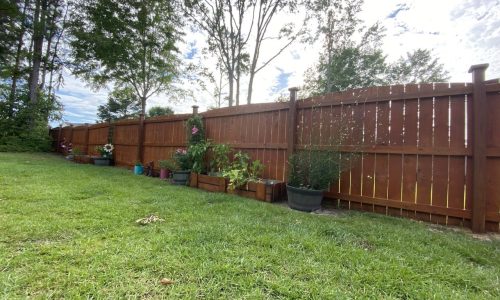
We stain fences across Lexington, Forest Acres, Chapin, Lake Murray, Gilbert, and Lake Murray Shores. From privacy fences on Highway 378 to split-rail fencing near Saluda Shoals Park, our fence stainers handle every wood type. Local context is on our Lexington exterior and Lake Murray pages.
Restaining Your Fence This Spring or Fall?
Fresh fence stain tightens the whole backyard look and protects wood through another decade of SC weather. If you want a licensed, insured fence staining crew that handles weathering checks, board repair, and color matching honestly, contact us for a free written estimate.
Stained our Lexington privacy fence in semi-transparent cedar tone. Finish looks rich and even.
Shannon Donnelly
Homeowner
Our Lake Murray fence was gray and tired. Solid stain refresh brought it back to new looking.
Antonio Reyes
Homeowner
Forest Acres fence got matched to our house trim exactly. Fair quote, crew finished in two days.
Valerie Chatterjee
Homeowner
Our new Chapin lake home fence weathered before stain. They tested, waited, did it right.
Trent Bateman
Homeowner
Pressure-treated fence wood needs six to twelve months of weathering before it accepts stain properly. The preservative treatment has to dry out of the surface, and stain applied too early beads off or peels within months. Cedar and redwood weather faster and can stain within a month of installation because they dry differently. Our fence stainers run a water-drop test during the estimate: if water soaks in, the wood is ready; if it beads, give it more time. Getting the timing right is more important than getting stain applied fast.
For residential fences in Lexington we specify oil-modified semi-transparent or solid stains from Benjamin Moore, Cabot, or Sherwin Williams depending on wood type and desired look. Pressure-treated fences take solid acrylic stains that handle UV and mildew without trapping moisture. Cedar takes semi-transparent stain that shows grain. The stain has to match the wood, the exposure, and the use. A one-product-fits-all approach guarantees either early peel or premature gray. Our fence stainers specify the exact product on every quote.
Yes, once it has weathered. Pressure-treated lumber comes saturated with preservative solution that has to dry before stain will bond. Six months is a reasonable wait for most Lexington installs; twelve months for fences installed in shaded or low-airflow lots. Once weathered, we pressure wash, let dry 48 to 72 hours, and apply semi-solid or solid stain. Staining pressure-treated before weathering is the most common fence staining failure we see in the field. Our fence stainers test readiness on every estimate walkthrough.
Semi-transparent is the most popular choice for cedar fences because it shows grain and weathers naturally. Solid stain is right for older fences, pressure-treated wood, and homeowners wanting strong color consistency; it covers grain completely. Clear sealer preserves natural tone but needs reapplication every year in SC humidity. As a full-service painting contractor, we walk through all three options with samples during the estimate. The right choice depends on wood type, age, and aesthetic preference.
Semi-transparent stain on a well-prepped Lexington fence typically holds three to five years on sun-facing panels, longer on shaded sides. Solid stain pushes five to seven years. Clear sealer runs one to two years and needs annual refresh. Lake Murray fences and properties under heavy tree cover often need refresh at the shorter end because of pollen and mildew buildup. Annual pressure washing extends stain life meaningfully without requiring recoating. When color looks tired on horizontal rails but verticals still look fine, restain before wood grays.
Yes. Every fence staining project starts with pressure washing to lift gray fibers, mildew, algae, and old finish. Our fence stainers use wood-rated cleaners and dial PSI to wood condition: lower on aged or soft wood to avoid grain raising, higher on pressure-treated that handles it. Wash has to dry 48 to 72 hours in Lexington humidity before stain goes down. For fences with thick solid stain that needs to come off, we sometimes add a stripper pass. For repair work, our fence repair team handles structural issues first.
Yes, though heavily weathered fences sometimes need more prep than homeowners expect. Gray fibers have to come off with pressure washing and sometimes a brightener. Cracked boards need evaluation for replacement. Semi-transparent stain on an old fence often needs to upgrade to solid stain to cover uneven weathering. Our fence stainers walk the fence during estimates and honestly quote what each option looks like: stain-only versus stain-with-replacement. Pushing stain onto a fence past its usable life is rarely the right recommendation, and we say so when we see it.
Stain colors range from natural wood tones (clear, honey, cedar) through medium browns (walnut, chestnut) to deeper tones (redwood, mahogany) and solid colors (charcoal, white, barn red). Match to existing house trim is common for homeowners wanting a coordinated backyard look. Our fence stainers bring physical sample stakes to every walkthrough so you see real color on real wood in real light. Digital swatches shift significantly against actual stained wood. Most Lexington homeowners pick from medium-brown through cedar tones, though deeper solids are trending in newer neighborhoods.

Yes, when the damage is within fence staining scope. Loose boards get re-secured, split boards get replaced, and minor rot gets epoxy fill before stain. For post replacement, leaning fence rebuilds, or structural damage, our outdoor wood team coordinates the repair as separate scope before stain crews arrive. Staining a structurally failing fence is wasted work. Our fence stainers flag structural issues on every walkthrough estimate rather than quoting stain-only on a fence that needs repair first.
A standard 150-foot residential privacy fence takes our fence stainers two working days from pressure wash to final coat, with overnight cure between wash and stain. Larger fences, stripping old finish, or extensive board replacement stretch the timeline to three or four days. Stain dry time runs 24 to 48 hours depending on humidity before the fence is fully safe from pets or rain. We publish a day-by-day schedule on every quote so you know when the backyard is off-limits for pets and furniture. Weather shifts timing occasionally but rarely dramatically.