
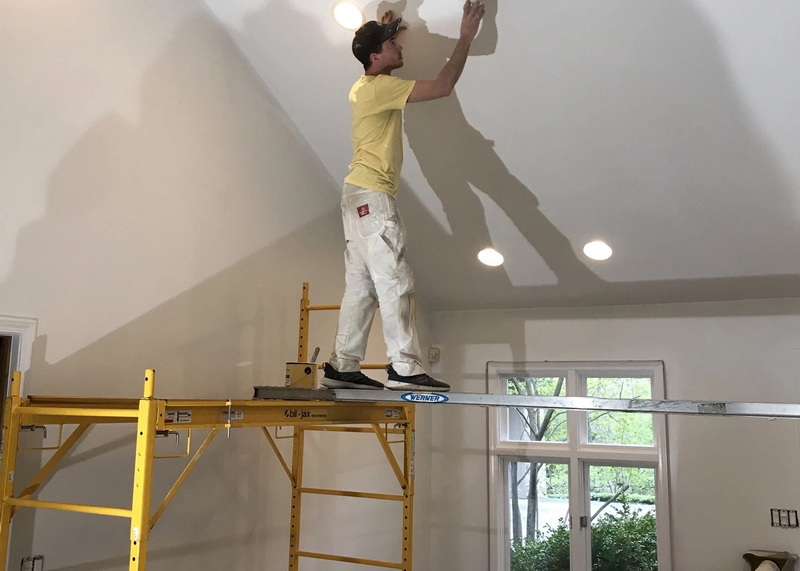
To paint a room with high ceilings safely, you need the right equipment, a solid plan, and a step-by-step approach that keeps you off unstable surfaces as much as possible. High ceilings, typically anything above 9 feet, are beautiful but they create real risks. According to the U.S. Bureau of Labor Statistics, there were 22,710 nonfatal ladder injuries in 2020 alone, and the CDC reports that 81 percent of all fall injuries in the United States involve a ladder. This guide covers every step, from choosing the right tools to picking the best paint colors, so you can get a professional result while staying safe.
How to Paint a Large Room With High Ceilings
Painting a large room with high ceilings follows a clear sequence: gather the right tools, prep the space, cut in the edges, then roll the open areas. The key difference from a standard room is access. You will spend more time planning how to reach the ceiling safely than you will actually painting it. Skipping this planning step is exactly how people get hurt.
Homeowners in Lexington, SC and the surrounding Lake Murray area often have homes with dramatic two-story entryways, vaulted great rooms, and tall stairwell walls. These spaces look stunning, but they require more preparation, more equipment, and more patience than a standard 8-foot ceiling job.
Here is the complete process from start to finish.
Step 1: Gather the Right Tools Before You Start
The tools you need to paint a room with high ceilings are an extension pole (12 feet or longer), a quality extension ladder or scaffolding, a roller with a thick nap cover, an angled cutting brush, painter’s tape, drop cloths, and safety goggles. You also need a paint tray and a sturdy bucket hook if you plan to carry supplies up a ladder.
Extension poles are your best friend on high-ceiling jobs. They let you apply paint from the ground, which reduces the number of times you have to climb. According to safety experts at the National Institute for Occupational Safety and Health (NIOSH), the most common cause of ladder falls is a ladder sliding out at the base, accounting for roughly 40 percent of incidents. Every time you can paint from the floor instead of a ladder, you cut your risk.
For ceilings up to 10 feet, a sturdy 6-foot stepladder with a built-in paint tray works well. For anything taller, an extension ladder or rolling scaffold is the safer choice. Many tool rental shops in the Columbia and Lexington, SC area rent interior scaffolding by the day or week, which is worth considering for large two-story spaces.
Step 2: Prep the Room Completely
Room prep for a high-ceiling space means removing all furniture you can move, covering everything else with drop cloths, taping trim and edges with quality painter’s tape, and turning off electricity to any ceiling fans or light fixtures. Do not skip the floor coverage. Drips from ceiling height fall a long way and can ruin hardwood or carpet below.
Clean the ceiling before you paint. Use a microfiber duster on an extension handle to remove cobwebs, dust, and loose debris. A dirty surface makes paint peel faster. Once it is clean, inspect for cracks or holes. Any damage should be patched and sanded smooth before the first coat of paint goes on.
If your ceiling has existing water stains, apply a stain-blocking primer before painting. Skipping primer on a stained ceiling means the stain will bleed through, no matter how many coats of paint you apply. For deeper ceiling damage or crumbling drywall, it makes sense to take care of sheetrock repair before paint prep even begins.
What Do Painters Use to Paint High Ceilings?
Professional painters use extension poles with roller covers, angled cutting brushes on extension adapters, airless paint sprayers, scaffolding or rolling lifts, and high-quality flat ceiling paint to paint high ceilings. Each tool plays a specific role.
Here is a breakdown of the main tools and when each one works best:
| Tool | Best For | Key Benefit | Limitation |
|---|---|---|---|
| Extension Pole + Roller | Open ceiling areas | Covers large areas fast from the floor | Hard to control cut-in lines |
| Angled Brush on Extension | Cutting in edges and corners | Clean lines without climbing | Requires practice for precision |
| Paint Sprayer | Very high or textured ceilings | Fast, smooth, even coverage | Needs heavy masking; more skill required |
| Scaffolding / Rolling Lift | Ceilings above 12 to 15 feet | Stable platform, wider reach | Setup time; must be rented |
| Stepladder | Ceilings up to 10 feet | Familiar, widely available | Must move it often; fall risk if rushed |
Sources: National Institute for Occupational Safety and Health (NIOSH); U.S. Bureau of Labor Statistics; Occupational Safety and Health Administration (OSHA)
Professional painters in the Lexington and Red Bank area who handle large two-story entryways or cathedral ceilings often prefer sprayers for the main ceiling field and rolling scaffolds for cut work. This combination is faster and reduces climb time significantly.
How Do Painters Reach High Ceilings?
Painters reach high ceilings by using extension poles from the floor whenever possible, and ladders or scaffolding when direct access is needed. The goal is always to minimize the number of climbs. Every trip up and down a ladder is a chance for something to go wrong.
For ceilings between 10 and 20 feet, a quality extension ladder is the standard choice. For anything above 20 feet, such as a vaulted great room or open foyer, scaffolding is the safer and more efficient option. According to the Occupational Safety and Health Administration (OSHA), falls from ladders are one of the leading causes of occupational fatalities in the construction industry. Taking shortcuts with equipment is never worth it.
When using an extension ladder, follow these rules every time. Place the base at roughly a 75-degree angle from the wall. Secure the feet on a flat, stable surface. Always maintain three points of contact, meaning two hands and one foot, or two feet and one hand, while climbing. Never stand on the top three rungs. Have a second person foot the ladder whenever possible, especially in occupied homes in the Gilbert or Lake Murray area where floors may be polished hardwood or tile.
Can You Paint a High Ceiling Without a Ladder?
Yes, you can paint a high ceiling without a ladder if your extension pole is long enough to reach the surface. Telescoping extension poles can reach up to 18 or even 24 feet, which covers many standard vaulted and two-story ceilings. For cutting in along edges, extension brush adapters clip onto most poles and let you work a brush along crown molding or ceiling lines without ever climbing.
The limitation is control. Paint applied from 15 feet below with a long pole has less precision than paint applied from 3 feet away on a ladder. Drips are also harder to catch before they fall. For open ceiling fields this is fine, but for tight cut-in lines or decorative ceilings, some ladder work is usually still needed.
Do Professional Painters Paint the Ceiling or Walls First?
Professional painters paint the ceiling first, then the walls. The reason is simple: ceiling paint drips and splatters onto the walls below. If you paint the walls first and then work on the ceiling, you risk ruining the finished wall paint with drips or roller splatter from above. Painting ceiling first, then walls, means any mess from the ceiling gets covered when the walls are done.
This order also applies to primer. Prime the ceiling, let it dry, then prime the walls. Then paint the ceiling, let it dry, then paint the walls. Following this sequence saves time and reduces touch-up work at the end of the job.
Homeowners in Lexington and the Forest Acres area who do their own painting often reverse this order and wonder why they have ceiling color bleeding into freshly painted wall surfaces. Ceiling first is the rule professionals follow on every job, from small bedrooms to large two-story great rooms.
What Are the Common Ceiling Painting Mistakes?
The common ceiling painting mistakes are skipping primer, overloading the roller, painting in one direction only, not cutting in before rolling, and rushing the dry time between coats. Each of these errors leads to visible problems that require extra work to fix.
Skipping primer is the biggest mistake. A bare or stained ceiling needs primer so the topcoat bonds correctly and covers evenly. Overloading the roller creates drips that dry as streaks or runs on the ceiling surface. Rolling in only one direction leaves lap marks that show up clearly once the paint dries. According to painting professionals, rolling perpendicular to the main light source in the room produces the smoothest final finish.
Not allowing enough dry time is another common problem. Most ceiling paints need at least two hours between coats, and some need four hours or more. Applying a second coat too early traps moisture and causes the surface to peel or bubble later. This is especially true in the humid climate of South Carolina, where interior humidity can slow paint dry times significantly.
What Not to Do When Painting a Ceiling
The things you should not do when painting a ceiling are: stand on the top step of a ladder, overreach while on a ladder, paint without drop cloths, skip taping trim, use a worn or damaged ladder, and work alone on a ceiling above 10 feet. These are the mistakes that lead to both safety incidents and poor paint quality.
Never overreach while on a ladder. The moment your hips go past the side rail of the ladder, you have lost your center of gravity. Moving the ladder takes two minutes. A fall from a ladder can mean weeks of recovery. The American Ladder Institute estimates that roughly 500,000 ladder injuries occur in the United States every year, many of them from people overreaching rather than simply repositioning the ladder.
Do not use a paint roller that is too dry. A dry roller pulls against the ceiling surface, causing the texture to tear or the existing paint to lift. Keep the roller evenly loaded and use smooth, overlapping strokes.
How Do I Get a Perfect Line Between My Wall and Ceiling?
To get a perfect line between your wall and ceiling, use high-quality painter’s tape applied directly along the ceiling line, cut in with a 2.5-inch angled sash brush before rolling, and apply the cut-in paint with light, steady pressure. Remove the tape while the paint is still slightly wet for the cleanest edge.
Many painters also use a paint edger tool for high ceilings. These tools have a thin guide pad that sits flush against the adjacent surface, helping you paint a straight line without tape. They are especially useful when cutting in from a ladder, because they reduce the hand movements you need to make at an awkward angle above your head.
Apply two coats of cut-in paint before rolling. The first coat seals the edge, and the second coat builds the coverage. If you roll right to the taped edge after cutting in, the rolled area and the brushed edge blend together naturally and the seam becomes invisible after drying.
Do You Cut In Twice When Painting?
Yes, most professional painters cut in twice when painting, once before the first coat is rolled and again before the second coat is rolled. Cutting in twice produces a more even finish because the first cut-in coat dries before you cut in the second time, which builds better coverage and hides any missed spots from the first pass.
On high ceilings, double cutting in is especially important because the distance from the painter to the surface means small misses are harder to see in real time. The second cut-in pass catches anything the first one missed. On interior painting jobs with high ceilings, professional painters often treat cut-in work as its own stage, completely separate from rolling.
What Colors Go With High Ceilings?
The colors that go best with high ceilings depend on the mood you want. Light colors like crisp whites, warm off-whites, soft blues, and pale grays make high ceilings feel even grander and more open. Deeper colors like navy, forest green, charcoal, and warm terracotta make a tall space feel cozier and more intimate.
White is the most popular choice. According to interior designers cited by Benjamin Moore, a bright white or warm white ceiling reflects light back into the room and helps high walls feel proportional rather than overwhelming. Soft neutrals like warm gray or cream work well on the walls beneath a white ceiling in large, light-filled rooms common to newer Lexington, SC neighborhoods and Lake Murray waterfront homes.
If you want to add drama, paint the ceiling two to three shades darker than the walls. Dark ceilings pull the eye upward and make a tall space feel anchored rather than echoing. This works especially well in living rooms or dining rooms where you want a cozy, sophisticated atmosphere.
How to Make a High Ceiling Room Look Cozy
To make a high ceiling room look cozy, paint the ceiling a darker shade than the walls, use warm-toned paint colors on the walls, add horizontal design elements like wide trim or wainscoting, and use layered lighting closer to floor level rather than relying only on overhead fixtures. Paint alone can transform the feel of a tall space dramatically.
Darker ceiling colors like deep navy, olive, slate, or warm brown draw the eye up and create the sensation of a lower, more intimate ceiling without physically changing the room. Design professionals recommend choosing a ceiling color two to three shades darker than the wall color for this effect. Warm undertones in the wall paint, such as creamy whites, soft taupes, or warm grays, add to the sense of comfort in a large, tall room.
Many families across the Columbia and Lexington area choose warm, neutral tones for two-story living rooms for this exact reason. A coat of the right paint color can make a large, cold-feeling space feel like a room the family actually wants to spend time in.
What Is the New Trend for Ceilings?
The new trend for ceilings is treating the ceiling as a design feature rather than an afterthought. Designers now refer to the ceiling as the “fifth wall,” and bold ceiling colors, painted patterns, and contrasting ceiling and trim color combinations are all gaining popularity. According to design experts at Benjamin Moore, elegant dark colors like deep green, black, and midnight blue on the ceiling are increasingly popular choices that highlight the height and architectural detail of a room.
Color-drenching, where the ceiling, walls, and trim are all painted the same bold color, is another growing trend that gives rooms a rich, tailored look. For homes in Lexington, SC and the surrounding area with high, architecturally detailed ceilings, this can be a stunning effect that adds significant visual interest without adding any new structures or fixtures.
Matte and ultra-flat finishes are also trending on ceilings because they hide surface imperfections while giving the paint a soft, velvety look. Gloss and semi-gloss finishes are gaining ground in dining rooms and modern kitchens as a bold, unexpected choice for ceiling treatment.
What Are the Three F’s of Interior Design?
The three F’s of interior design are Form, Function, and Finish. Form refers to the shape and structure of the space. Function refers to how the space is used. Finish refers to the surface treatments, including paint color and sheen, that define how the room looks and feels. All three must work together for a room to feel complete and cohesive.
Paint plays a central role in the Finish component. The right ceiling color, wall color, and sheen level all work together to support both the form of the room (by making tall ceilings feel proportional) and the function of the space (by creating the right mood for relaxing, working, or entertaining). Homeowners in the Red Bank and Chapin areas often overlook paint sheen as a design variable, but it makes a significant difference in how a finished room feels in different lighting conditions throughout the day.
What Are Common High Ceiling Design Mistakes?
Common high ceiling design mistakes are using the wrong paint color that makes the room feel cold or hollow, using only overhead lighting which flattens the space, failing to add visual weight at lower levels to balance the height, and leaving the ceiling itself plain white when a more intentional color choice would add character.
Another common mistake is using a flat paint with no preparation on a high ceiling that has visible imperfections. Flat paint does hide flaws, but only when the surface has been properly primed and the sheen level is appropriate for the space. A glossy or even eggshell finish applied to a rough or patchy high ceiling will catch every light source in the room and highlight every flaw. Always prime high ceilings before painting, especially after any patching work.
Choosing the wrong roller nap thickness is also a frequent mistake on textured high ceilings. Smooth ceilings need a 3/8-inch nap roller. Lightly textured surfaces need a 1/2-inch nap. Heavily textured or acoustic ceilings need a 3/4-inch or thicker nap to get paint into all the surface variations. Using the wrong nap leaves thin spots and requires extra coats.
What Are the Most Common Painting Mistakes?
The most common painting mistakes are skipping surface prep, using cheap paint, not using primer, applying paint that is too thick, painting in poor lighting, not protecting floors and trim, and rushing through the project. Every one of these errors is visible in the final result and usually requires additional work to correct.
Cheap paint is a particularly costly mistake on high ceilings. Higher-quality paints have more concentrated pigments, which means better coverage in fewer coats. On a ceiling 15 or 20 feet up, every coat saved is time you are not spending on a ladder. Premium paints also hold up longer, which matters for a surface that is hard to access for touch-ups.
Poor lighting is another issue that is easy to overlook. When you are painting a high ceiling with limited natural light, you need work lights positioned to illuminate the surface from an angle. Without good lighting, you miss thin spots and overlap lines that will be clearly visible once daylight hits the ceiling at a different angle. Many professional painters working in occupied homes around Lexington set up battery-powered work lights before starting any ceiling work.
What Is the 3-5-7 Rule of Decorating?
The 3-5-7 rule of decorating is a design principle that says items in a room look best when grouped in odd numbers, specifically groups of three, five, or seven. This applies to decorative objects, lighting fixtures, and even color distribution across walls and ceiling. When it comes to paint, the principle supports using three distinct but coordinated tones: one for the ceiling, one for the walls, and one for the trim. This three-tone approach creates a layered, finished look that professional designers use consistently.
Applied to a high-ceiling room, this means choosing a ceiling color, a wall color, and a trim color that all relate to each other without being identical. A common example is a warm white ceiling, a soft greige wall color, and bright white trim. The contrast between all three elements gives the room visual structure without being visually busy.
How to Paint a Large Room With High Ceilings: The Full Step-by-Step Process
Here is the complete step-by-step process for painting a large room with high ceilings safely and professionally.
Step 1: Clear and Protect the Room
Remove all furniture you can carry out. Push larger pieces to the center and cover them with plastic sheeting. Lay drop cloths across the entire floor and overlap the edges so there are no gaps. Remove or cover ceiling fans and light fixtures. Turn off the electricity to the room at the breaker panel.
Step 2: Clean and Repair the Ceiling
Dust the ceiling using a microfiber duster on an extension pole. Fill any holes or cracks with lightweight spackling compound. Sand smooth once dry. For larger areas of ceiling damage, a proper drywall repair is the right starting point before any paint goes on the surface.
Step 3: Apply Primer
Apply a quality interior primer to the ceiling, especially on any patched areas or stained spots. Use the same extension pole setup you plan to use for painting. Allow the primer to dry completely before painting. Skipping primer leads to uneven coverage and paint that does not bond well to the surface.
Step 4: Set Up Your Access Equipment
Position your ladder or scaffolding before you open a single can of paint. Set the ladder on flat, stable flooring. If the floor is uneven, use rubber pads or ladder levelers under the feet. Check that all locks are engaged. Have a second person present whenever you are working above 10 feet.
Step 5: Cut In the Ceiling Edges
Using a 2.5-inch angled brush, cut in a 3-inch band of paint around the entire perimeter of the ceiling where it meets the wall. Work in sections. If using a ladder, move it every 4 to 6 feet rather than overreaching. Allow the cut-in paint to dry before rolling if you want crisp, clean lines.
Step 6: Roll the Ceiling
Attach the roller to your extension pole and load it evenly with paint. Start in one corner and work in 3-foot-by-3-foot sections. Roll in overlapping W or M shapes to distribute paint evenly. Keep the roller moving at a consistent pace to avoid lap marks. Roll perpendicular to the main light source for the smoothest finish.
Step 7: Apply the Second Coat
Allow the first coat to dry fully, usually 2 to 4 hours in normal conditions. In humid South Carolina weather, allow extra time. Apply the second coat using the same cut-in-then-roll sequence. The second coat builds coverage and hides any thin spots the first coat left behind.
Step 8: Paint the Walls
Once the ceiling is completely dry, move on to the walls. Cut in along the ceiling line first, then roll the wall surfaces. Painting the walls last means any drips or splatter from the ceiling work are covered by the fresh wall paint. This is the professional sequence used on house painting projects of all sizes.
Step 9: Remove Tape and Clean Up
Pull painter’s tape at a 45-degree angle while the paint is still slightly tacky. Pulling at a sharp angle prevents the tape from lifting the dry paint edge with it. Clean all brushes and rollers immediately after use. Dispose of used materials according to your local guidelines for paint waste.
Frequently Asked Questions
How to Paint High Ceilings Safely in a Lexington, SC Home?
To paint high ceilings safely in a Lexington, SC home, use a sturdy extension ladder set at the correct 75-degree angle, maintain three points of contact at all times, have a second person present to stabilize the base, and use extension poles from the floor whenever possible to reduce the number of climbs. According to the CDC, about 40 percent of ladder fall injuries happen because the ladder slides out at the base from an incorrect setup angle. In older Lexington homes with hardwood or tile floors, always use rubber feet or a non-slip mat under the ladder base.
Do I Need Scaffolding to Paint a Vaulted Ceiling?
You need scaffolding to paint a vaulted ceiling if it is above 12 to 15 feet and you want to do cut-in work safely from a stable platform. For the open ceiling field, a long extension pole can reach most vaulted ceilings from the floor. Interior scaffolding can be rented at many tool rental locations in the Columbia and Lexington, SC area and delivers a stable working platform that significantly reduces fall risk compared to a standard ladder on high-ceiling jobs.
What Is the Best Paint Finish for High Ceilings?
The best paint finish for high ceilings is flat or matte. Flat ceiling paint hides imperfections, minimizes glare, and dries without sheen, which means surface variations are harder to see once the paint is dry. High-sheen finishes like eggshell or semi-gloss catch light at different angles and highlight every patch, roller mark, and texture variation. For humid climates like Lexington and Lake Murray in South Carolina, use a flat paint with mildew-resistant properties in rooms with limited ventilation.
How Long Does It Take to Paint a High Ceiling Room in the Lexington Area?
Painting a single high-ceiling room in the Lexington, SC area typically takes one full day for a skilled DIYer and half a day for an experienced professional crew. This includes prep, priming, two coats of ceiling paint, and two coats of wall paint. Rooms with textured ceilings, existing stains, or heights above 15 feet take longer. According to painting industry estimates, plan for about one hour per 400 square feet of ceiling at standard height, with extra time added for every additional foot of ceiling height.
When Should I Hire a Professional to Paint High Ceilings?
You should hire a professional to paint high ceilings when the ceiling is above 12 feet, when the room has a complex layout like a stairwell or vaulted structure, when there is existing water damage or surface texture that needs repair, or when you are not comfortable working on a ladder. Falls from ladders result in more than 22,000 injuries annually in the United States, according to the U.S. Bureau of Labor Statistics. Hiring a professional is the safest and most efficient choice for any ceiling above standard height in a Gilbert, Red Bank, Chapin, or Lake Murray area home.
Does Painting High Ceilings Add Value to a Home?
Yes, professionally painted high ceilings do add value to a home by improving the overall appearance, protecting the surface from moisture and staining, and making the space feel finished and well-maintained. Real estate agents in the Lexington and Columbia, SC market consistently report that fresh, clean interior paint is one of the highest-return improvements a homeowner can make before listing a property. High ceilings are a premium architectural feature in the local market, and a freshly painted ceiling highlights that feature rather than hiding it under dingy, dated paint.
What Is the Safest Way to Paint Above a Staircase in Lexington, SC?
The safest way to paint above a staircase in Lexington, SC is to use interior scaffolding or a stair-specific ladder system with adjustable legs that allow the ladder to sit level on uneven stair surfaces. Extension poles with brush attachments can handle much of the open wall area without any climbing. Never use a standard stepladder on stair steps, as the uneven surface creates serious instability. For large, two-story stairwells that are common in newer construction neighborhoods around the Lake Murray area, professional painters with scaffolding experience are the safest and fastest choice.
Final Thoughts
Painting a room with high ceilings safely comes down to three things: the right tools, a patient and methodical approach, and a commitment to not taking shortcuts with ladder and scaffold safety. From gathering equipment to applying the final coat, every step in this process has a right way and a risky way. Following the right way takes more time upfront but saves you from injury, rework, and frustration. The data is clear. The U.S. Bureau of Labor Statistics and CDC both show that ladder-related injuries are one of the most common and most preventable home improvement hazards in the country. Proper setup, extension poles wherever possible, and having a spotter when climbing are simple habits that dramatically reduce your risk.
When the job feels too big, too tall, or too complex, the smartest move is calling a professional. The team at Soda City Painting serves homeowners across Lexington, Red Bank, Gilbert, Chapin, and the Lake Murray area with high-end interior painting that covers rooms of all sizes and heights. From two-story entryways to vaulted great rooms, the crew handles every detail of the job, including prep, primer, cut work, and cleanup, so you get a flawless finished ceiling without ever climbing a ladder. Contact Soda City Painting today to schedule your free estimate and see what professional interior painting services can do for your home.