
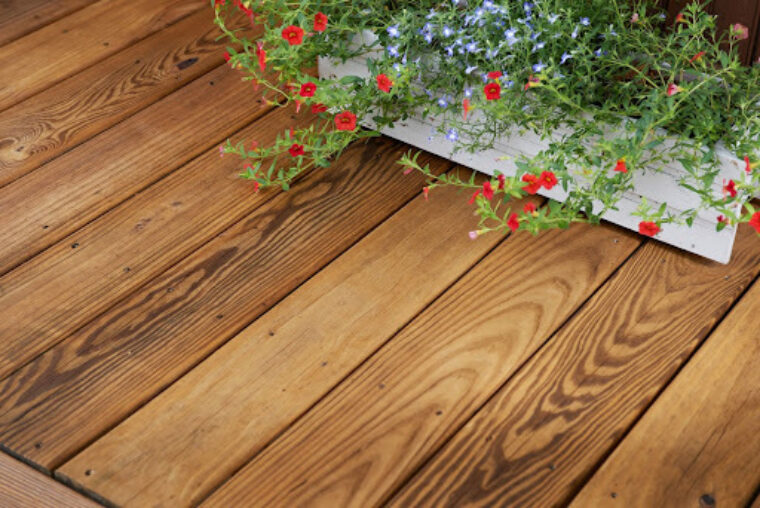
To protect your deck with the right stain, choose a high-quality penetrating oil-based or water-based deck stain that matches your wood type, climate, and the level of UV and moisture protection you need. The right stain soaks into the wood fibers, blocks UV rays, repels water, and prevents mold and mildew, all while enhancing the natural beauty of the wood. According to Consumer Reports, the best wood stains last three to five years on a deck before needing reapplication. This guide explains how to choose the right stain type, how to prep and apply it, the best time of year to stain, common mistakes to avoid, and answers to the top questions homeowners in Lexington, SC ask about deck staining and protection.
What Should I Protect My Deck With?
You should protect your deck with a penetrating deck stain that includes UV blockers and water repellents. Stain is better than paint for decks because it soaks into the wood instead of forming a film on top. Paint sits on the surface and eventually peels, chips, and cracks under foot traffic and weather exposure. Stain penetrates the wood and protects it from the inside out.
According to This Old House, stain offers several benefits over paint for decks. Stain enhances the wood’s natural features, does not peel or chip like paint, and requires less prep work when it is time to reapply. Paint can work on some outdoor surfaces, but it is generally not the best choice for decks because the film it forms breaks down under heavy use.
For most decks in Lexington, SC, a semi-transparent oil-based stain provides the best balance of protection, appearance, and longevity. It lets the wood grain show through while adding color and blocking UV damage. Homeowners with older or imperfect decks may prefer a solid stain, which hides flaws and provides the strongest UV and moisture barrier. Professionals who handle decks, docks, and fences can help you pick the right product for your specific wood and conditions.
What Is the Best Longest Lasting Deck Stain?
The best longest lasting deck stain is a solid or semi-solid oil-based stain from a premium brand like TWP, Cabot, Ready Seal, or Benjamin Moore Arborcoat. Solid stains last the longest, typically 4 to 8 years on a deck, because they contain the most pigment and provide the strongest UV and moisture protection. Semi-transparent stains last 2 to 4 years, and clear sealers last 1 to 2 years.
According to Consumer Reports, the most durable stains last three to five years on a deck and even longer on vertical surfaces like fences and siding. The testing engineer who leads Consumer Reports’ wood stain program noted that sun, water, snow, dirt, and mildew all beat down on a deck’s flat surface, which is why horizontal surfaces wear faster than vertical ones.
According to DeckStainHelp.com, a leading deck stain review site, TWP 1500 Series Semi-Transparent Stain consistently ranks as one of the top options for decks thanks to its deep-penetrating formula, UV resistance, mold resistance, and long-lasting color. For homeowners in the Lexington, SC area, an oil-based penetrating stain with strong UV blockers is the best long-term investment for a deck that sees heavy sun exposure during South Carolina’s hot summers.
What Is the Longest Lasting Deck Coating?
The longest lasting deck coating is an elastomeric deck coating or a solid deck stain. Elastomeric coatings are thick, flexible coatings that stretch with the wood as it expands and contracts. They can last 10 to 15 years on a well-prepared surface. Solid stains last 4 to 8 years and provide excellent UV and moisture protection while covering imperfections in the wood.
Deck resurfacing products are another long-lasting option for older, worn-out decks. These thick coatings fill cracks, smooth rough surfaces, and create a new, durable finish. They are best for decks that are too damaged for a standard stain but still structurally sound. According to DeckStainHelp.com, deck resurfacing products can extend the life of an aging deck by several years.
For homeowners near Lake Murray and Columbia, SC who have older decks with surface wear but good structural bones, a deck resurfacing product or solid stain provides the longest-lasting protection without the expense of a full deck replacement.
How Many Years Should a Deck Stain Last?
A deck stain should last 2 to 5 years on average, depending on the type of stain, the quality of the product, the climate, and how much foot traffic the deck gets. Clear sealers last 1 to 2 years. Semi-transparent stains last 2 to 4 years. Semi-solid stains last 3 to 5 years. Solid stains last 4 to 8 years.
According to Consumer Reports, the best wood stains last three to five years on a deck. The worst stains look terrible after just one year. The difference comes down to the quality of the product, the prep work, and how the stain was applied. A premium stain applied to a clean, dry, properly prepared deck will always outlast a budget product slapped on without prep.
According to Angi, a properly applied coat of fence stain lasts between 3 and 8 years depending on climate. The same ranges apply to decks. In the humid, sun-heavy climate around Lexington, SC, expect stain to need reapplication on the shorter end of that range. A simple water test tells you when it is time to restain: pour water on the deck surface. If it beads up, the stain is still working. If it soaks in, the protection has worn off.
Why Does My Deck Stain Peel Off Every Year?
Your deck stain peels off every year because of one or more of these issues: the wood was not properly cleaned before staining, the stain was applied to damp wood, too much stain was applied in a single coat, or the stain is not compatible with the existing finish on the wood.
The most common cause of peeling is moisture trapped under the stain. If the wood is not completely dry when the stain is applied, the moisture pushes the stain off as it tries to escape. According to Cabot Stain, stain applied to damp surfaces will not adhere well and can crack or peel. The wood should be clean, dry, and free of any previous finish that could prevent the new stain from penetrating.
Another common cause is over-application. According to Cabot, more stain is not better. If you over-apply, stain may peel or crack when exposed to moisture, or produce a sticky surface that prevents proper drying. One thin, even coat is almost always better than a heavy coat. For new decks, most oil-based stain manufacturers recommend only one coat. Homeowners in Lexington, SC who experience peeling should strip the old stain, clean and brighten the wood, let it dry for 48 hours, and apply a single thin coat of a quality penetrating stain.
Can I Put New Wood Stain Over Old Stain?
You can put new wood stain over old stain only if the old stain is still in good condition, with no peeling, flaking, or cracking. If the existing stain is a penetrating oil-based stain that has simply faded, you can clean the deck, let it dry, and apply a fresh coat of the same type of stain directly over it.
If the old stain is peeling, flaking, or a different type than the new stain, you need to strip the old finish first. According to DeckStainHelp.com, when switching brands of deck stain, it is always best to remove the old coating first by using a deck stain stripper and/or sanding. Always apply a wood brightener after stripping to neutralize the pH and open the wood pores.
Putting a water-based stain over an old oil-based stain without stripping will cause adhesion failure. The new stain will not bond to the old oil layer and will peel quickly. Homeowners near Red Bank, SC who are restaining their decks should test a small area first and check the manufacturer’s recommendations for compatibility. Professional exterior painting and staining teams know how to identify the existing finish and prep accordingly.
What Is the Best Month to Stain a Deck?
The best month to stain a deck depends on your location, but in Lexington, SC and the Southeast, late September through early November and late March through May offer the best weather for deck staining. You need temperatures between 50 and 90 degrees Fahrenheit, low humidity, no rain in the forecast for 24 to 48 hours, and no direct hot sunlight on the surface.
According to Consumer Reports, wood stain will not adhere well to damp wood and can crack and peel if applied in the wrong conditions. Apply stain to dry wood when it has not rained for several days and the forecast calls for at least two days of dry weather. Low-to-average humidity promotes faster drying.
According to Cabot Stain, apply stain when air and wood surface temperatures are between 50 and 90 degrees. Avoid applying in direct sunlight. In the Lexington, SC area, spring and fall offer the most consistent staining weather. South Carolina summers bring extreme heat and daily thunderstorms that make staining risky. Early morning or late afternoon application is best during warmer months.
Is October Too Late to Stain a Deck?
No, October is not too late to stain a deck in Lexington, SC. October is actually one of the best months for deck staining in the Southeast. Temperatures are typically between 55 and 80 degrees, humidity drops from summer highs, and rain is less frequent. As long as daytime temperatures stay above 50 degrees and you have 2 to 3 dry days in a row, October is an excellent time to stain.
In colder climates, October can be a risky month if overnight temperatures drop below freezing before the stain has cured. But in South Carolina, October’s mild nights give the stain plenty of time to penetrate and dry. Always check the extended forecast and the stain manufacturer’s minimum temperature requirement before starting.
Is It Better to Brush or Roll Stains on a Deck?
It is better to brush stain on a deck for the best penetration and finish. A natural bristle brush works the stain deep into the wood fibers and cells, giving you the most thorough coverage and the longest-lasting protection. According to Cabot Stain, natural bristle brushes are the best choice for effectively working the stain into the wood.
Rolling is faster for covering large areas, but the roller does not push the stain into the wood as deeply as a brush. If you roll, go back with a brush to work the stain in. Spraying is the fastest method, but you must back-brush after spraying to push the stain into the wood grain. According to Consumer Reports, synthetic brushes are ideal for water-based stains, while natural bristle brushes work best with oil-based stains.
For large decks in the Lexington, SC area, the spray-and-back-brush method is the most efficient approach. Professional teams that stain decks and docks use this method to cover big surfaces quickly while still getting full penetration into the wood.
Can I Use Dawn Dish Soap to Clean My Wood Deck?
Yes, you can use Dawn dish soap mixed with warm water to clean a lightly dirty wood deck. A solution of a few squirts of Dawn in a bucket of warm water works well for removing surface dirt, pollen, and light grime. Scrub with a stiff-bristle brush and rinse with a garden hose.
For heavier dirt, mold, mildew, or old stain residue, a dedicated deck cleaner from a brand like Cabot, Olympic, or Behr provides a more thorough cleaning. Deck cleaners are formulated to remove oxidation and open the wood pores so the new stain can penetrate properly. After cleaning, always apply a wood brightener to restore the wood’s natural pH and color before staining.
Homeowners near Gilbert, SC and Lake Murray should avoid using bleach on their decks, as it can damage the wood fibers and leave the surface fuzzy. A commercial wood cleaner followed by a brightener is the safest and most effective prep method. Proper cleaning before staining is the single biggest factor in how long the stain lasts.
What Is the 3/4/5 Rule for Decks?
The 3/4/5 rule for decks is a measurement method used to make sure a deck is built square. It comes from the Pythagorean theorem: measure 3 feet along one side, 4 feet along the other, and the diagonal between those two points should be exactly 5 feet. If it is, your corner is a perfect 90-degree angle. If it is not, the deck frame needs to be adjusted.
This rule applies during deck construction, not staining. But it is important because a properly built, square deck is easier to maintain, stain, and repair over its lifetime. Poorly built decks develop gaps, uneven boards, and drainage problems that can cause stain to fail faster. According to industry professionals, a well-built deck with proper drainage and ventilation can last 20 to 30 years with regular staining and maintenance.
How to Winter Proof Your Deck?
To winter proof your deck, clean it thoroughly, repair any damage, apply a fresh coat of stain or sealer if needed, and clear it of furniture and debris before the first freeze. The stain creates a moisture barrier that protects the wood from rain, snow, and the freeze-thaw cycles that cause cracking and warping.
According to Cabot Stain, when it snows, remove snow with a push broom or leaf blower instead of a shovel to prevent scratching and peeling. Salt-based ice melters can damage wood decks, so use calcium chloride or sand instead. Keeping the deck clear of leaves, branches, and standing water prevents moisture from getting trapped against the wood and causing mold or rot.
Homeowners in Lexington, SC do not face harsh winters like northern states, but the area does get occasional freezing temperatures, ice storms, and heavy rain. A fresh coat of stain before winter, combined with regular sweeping and debris removal, keeps decks in great shape through the cooler months. Residential painting and staining teams can apply a protective coat in the fall to seal the wood before winter weather arrives.
How Many Times Should You Stain a Deck?
You should stain a deck every 2 to 5 years, depending on the type of stain, the climate, and how much wear the deck gets. Clear sealers need reapplication every 1 to 2 years. Semi-transparent stains last 2 to 4 years. Solid stains can last 4 to 8 years before needing a fresh coat.
According to This Old House, how often you need to restain depends on the type of stain, the wood, foot traffic, and the climate. The water bead test is the quickest way to check whether your stain is still working. If water soaks into the wood instead of beading on the surface, the protection has worn off and it is time to restain.
For decks in the Lexington, SC area that get heavy sun and humidity, plan on restaining every 2 to 3 years with a semi-transparent stain, or every 4 to 5 years with a solid stain. Regular maintenance, including annual cleaning and inspections, extends the time between staining sessions.
What Wood Stain Is Popular Now?
The wood stain that is popular now is a warm, natural tone in the semi-transparent category. Warm cedar, honey oak, light walnut, and driftwood gray are the most popular deck stain colors in 2025 and 2026. Homeowners are choosing stains that enhance the natural wood grain while adding subtle color and protection.
According to Angi’s 2024 State of Home Spending Report, homeowners are favoring simpler palettes and natural finishes for their outdoor spaces. According to a 2024 survey by Clever Real Estate, white, beige, and light gray are the most popular interior colors, and that neutral trend extends to exterior stains. Natural wood tones that complement the home’s exterior palette are the top choice.
For decks around Lexington, SC and the Lake Murray shoreline, warm cedar and honey tones look great against the natural surroundings. A medium brown or weathered gray stain is a popular choice for homeowners who want a modern, low-key look. Professional house painting teams can help you select a stain color that complements your home’s exterior.
Deck Stain Type Comparison
| Feature | Clear Sealer | Semi-Transparent Stain | Semi-Solid Stain | Solid Stain |
|---|---|---|---|---|
| Wood Grain Visibility | Full grain visible | Most grain visible | Some grain visible | No grain visible |
| Typical Lifespan on Deck | 1 to 2 years | 2 to 4 years | 3 to 5 years | 4 to 8 years |
| UV Protection | Low | Moderate | Good | Excellent |
| Hides Imperfections | No | Slightly | Moderately | Completely |
| Moisture Protection | Moderate | Good | Very Good | Excellent |
| Prep for Restaining | Light cleaning | Cleaning and light prep | Moderate prep | Full stripping may be needed |
| Best For | New, beautiful wood | Good condition wood | Older wood with some wear | Old or imperfect wood |
Sources: Consumer Reports wood stain testing program; This Old House deck stain guide; Cabot Stain product line; DeckStainHelp.com annual stain reviews; Angi deck staining cost data
Is Cabot or Behr Deck Stain Better?
Cabot and Behr are both solid deck stain brands, but they perform differently depending on the product line and stain type. Cabot is a premium brand known for deep-penetrating oil-based stains that are popular with professional painters and deck staining contractors. Behr is widely available at Home Depot and offers a broad range of affordable stains with good water resistance.
According to Consumer Reports testing, some Behr and Cabot products performed well while others scored poorly in long-term durability tests. The best approach is to compare specific products within each brand rather than choosing based on the brand name alone. For Lexington, SC homeowners, Cabot Australian Timber Oil and Behr Premium Semi-Transparent Stain are both strong options for pressure-treated and cedar decks.
Frequently Asked Questions
How Long Should a New Deck Dry Before Staining in Lexington, SC?
A new deck should dry for at least 3 to 6 months before staining. Pressure-treated wood is saturated with chemicals and moisture from the treatment process and needs time to dry out. According to DeckStainHelp.com, new decks cannot be stained right away, even if the wood is kiln-dried. Let the wood weather for several months, then clean and brighten it before staining. In the humid climate around Lexington, SC, allow extra drying time.
Can I Stain My Deck in October in South Carolina?
Yes, you can stain your deck in October in South Carolina. October is one of the best months for deck staining in the Lexington, SC area. Temperatures are mild, humidity is lower, and rain is less frequent. Check the forecast for 2 to 3 dry days before starting. Make sure daytime temperatures are above 50 degrees and nighttime temperatures do not drop below freezing.
What Is the Best Deck Stain for Pressure-Treated Wood Near Columbia, SC?
The best deck stain for pressure-treated wood near Columbia, SC is a semi-transparent or semi-solid oil-based penetrating stain. Oil-based stains soak deep into the treated wood and provide strong UV and moisture protection. According to Imperial Painting, pressure-treated wood has varied absorption rates, so a penetrating stain that adapts to those differences gives the best result. Let the wood dry for 3 to 6 months after installation before staining.
How Do I Know When My Deck Needs Restaining?
You know when your deck needs restaining by doing a water test. Pour a small amount of water on the deck surface. If the water beads up, the stain is still protecting the wood. If the water soaks into the wood, the stain has worn off and it is time for a new coat. Other signs include fading color, graying wood, peeling, and visible mold or mildew. According to Cabot, if the stain is still repelling water, it is still performing.
Should I Stain or Seal My Deck in Lexington, SC?
You should stain your deck in Lexington, SC rather than just sealing it. A clear sealer provides moisture protection but very little UV protection, and it only lasts 1 to 2 years. A stain with pigment blocks UV rays, resists moisture, prevents mold, and lasts 2 to 5 years or longer. According to This Old House, solid stains offer the highest level of protection with maximum UV defense and excellent water resistance. For the best long-term value, choose a semi-transparent or semi-solid stain with UV blockers.
How Much Does It Cost to Stain a Deck Professionally?
The cost to stain a deck professionally ranges from $2 to $10 per linear foot, or between $750 and $4,250 total, according to Angi. The price depends on the size of the deck, the condition of the wood, the type of stain, and how much prep work is needed. DIY staining saves around 60% on labor costs but takes significantly more time. For homeowners in Lexington, SC, hiring a professional ensures proper prep, even application, and a longer-lasting finish.
Can I Stain My Deck on a Cloudy Day?
Yes, a cloudy day is actually ideal for staining a deck. Clouds block direct sunlight, which prevents the stain from drying too fast before it can soak into the wood. According to Consumer Reports, staining in direct sunlight can be a problem because the stain dries too fast for the wood to absorb it. A cloudy day with temperatures between 50 and 85 degrees and no rain in the forecast is perfect staining weather in Lexington, SC.
Final Thoughts
Protecting your deck with the right stain is one of the smartest home maintenance investments you can make. The right stain blocks UV damage, repels moisture, prevents mold and mildew, and keeps the wood looking great for years. Choose a quality penetrating stain that matches your wood type and climate, prep the surface thoroughly, apply one to two thin coats with a brush or sprayer and back-brush method, and plan to restain every 2 to 5 years.
If you are a homeowner in Lexington, SC, the Lake Murray area, Red Bank, Gilbert, or anywhere around Columbia, and your deck needs staining, sealing, or a full refresh, Soda City Painting is ready to help. Their team specializes in deck, dock, and fence staining and brings the products, tools, and experience to deliver a finish that lasts. Call (803) 221-0771 or visit their website to request your free estimate today.