To match existing paint color on your walls, you have five reliable options: look up the original paint formula using the color name saved on the can label, bring a paint chip scraped from the wall to a paint store for spectrophotometer matching, use a handheld color sensor device, scan the wall with a smartphone color-matching app, or compare paint swatches against the wall under natural light. Each method has a different level of accuracy and works better in certain situations. This guide covers every approach in detail, explains why touch-up paint so often does not match even when it should, and tells you exactly how to apply touch-up paint without it showing, so homeowners in Lexington, South Carolina can make confident decisions about their walls.
Is There a Way to Match Paint Color Already on a Wall?
Yes, there is a way to match paint color already on a wall. The most accurate method is to take a physical paint chip from an inconspicuous area of the wall, such as behind a switch plate or outlet cover, and bring it to a paint store that has a spectrophotometer. The machine reads the color sample and compares it against a database of thousands of formulas to find the closest match. According to HowStuffWorks and House Beautiful, spectrophotometer color matching is typically about 90% accurate, with accuracy depending on the quality of the machine’s filters and software. Stores using units with 31 interference filters produce more reliable matches than those with fewer filters.
Other methods exist and work well in certain situations, but none of them are as consistently accurate as a clean, well-preserved physical chip analyzed by a quality spectrophotometer. Phone apps are convenient but limited by camera sensors and lighting conditions. Swatch comparison is helpful for eliminating options but rarely pinpoints an exact match. The best starting point is always a physical sample from the actual wall.
How to Find the Exact Color of Your Wall Paint
To find the exact color of your wall paint, work through these options in order from most to least reliable: check the paint can label for the original formula, scrape a chip for store matching, use a handheld color sensor, use a color-matching app, or compare swatches in person.
Method 1: Check Your Saved Paint Can or Label
The most direct way to find the exact color of your wall paint is to check your original paint can. Most paint stores print the formula label and stick it on the can lid at the time of purchase. This label shows the color name, the base paint used, and the exact pigment formula. If you still have the can, the store can remix that exact formula, giving you a perfect batch match rather than a color approximation. According to Benjamin Moore’s touch-up paint guide, labeling paint cans with the room name and date is one of the most valuable habits a homeowner can develop for future repairs. Even if the paint has dried out in the can, the label alone is enough for any paint store to reproduce the formula precisely.
If you do not have the can, check behind electrical outlet covers or light switch plates. These spots were typically masked off during painting and hold the original color in protected condition, unaffected by UV fading or surface soiling. A chip cut from these areas is the cleanest and most reliable sample you can bring to a store for matching.
Method 2: Bring a Paint Chip to a Store for Spectrophotometer Matching
If you do not have the original can or formula, scrape a small sample from the wall, about the size of a quarter, from a hidden area like inside a closet or behind a door. Bring the chip to a paint store with a spectrophotometer. The machine beams light onto the sample, measures the wavelengths of reflected light, and converts that data into a color formula that the store can mix. According to Allison Smith Design, for the most accurate result, a quality store will use the spectrophotometer reading as one reference point and then verify the formula by eye, because no machine alone achieves absolute perfection. A trained colorist adjusting the formula by eye after the machine reading is what produces the best result.
Two important factors affect how accurate a chip match can be. First, the chip must be clean. Dirt, grease, or a sheen from a glossy paint finish can scatter light and throw off the machine’s reading, according to HowStuffWorks. Second, any UV fading on the chip will produce a match to the faded color rather than the original formula. If the chip comes from a sun-exposed area and the wall has been up for several years, the matched formula will reproduce the faded version of the color, not the original. For the best chip, always take it from a shaded, protected area of the wall.
Method 3: Use a Handheld Color Sensor Device
Handheld color sensor devices are small tools that you press against a painted wall to scan its color and return a matched formula from a specific paint brand’s library. According to the Commercial Painting Industry Association (CPIA), the Nix Pro 2 color sensor, priced at approximately $349, can complete over 5,000 scans before needing a recharge and is compatible with multiple color standard systems. The Sherwin-Williams ColorSnap Precision device, priced at $79.99, is specifically calibrated to match Sherwin-Williams colors and reportedly achieves a 96% or higher match rate against the company’s fan deck. These tools are useful because they allow you to scan directly on the wall without removing any paint, making them ideal for large walls or surfaces where taking a chip is not practical.
Method 4: Use a Smartphone Color-Matching App
Smartphone apps like Sherwin-Williams ColorSnap Visualizer and Benjamin Moore’s Color Portfolio allow you to photograph a wall and identify the closest paint color match from the brand’s library. These apps are convenient and free, but they carry important limitations. Camera sensors on smartphones do not measure light wavelengths the way a spectrophotometer does. They capture an approximation of color as seen by the camera, which varies significantly depending on ambient lighting, shadows, and the camera’s white balance settings. According to a color-matching guide from Sharper Impressions Painting, phone apps work best in well-lit areas near natural light sources, but they may not account for paint finish or subtle color nuances that a physical chip match would catch.
Phone apps are a good starting point for identifying a color family and narrowing down options, but they are not precise enough for an exact match on their own. Use them to generate a short list of candidates and then confirm the final choice by testing paint samples directly on the wall.
Method 5: Compare Paint Swatches Against the Wall
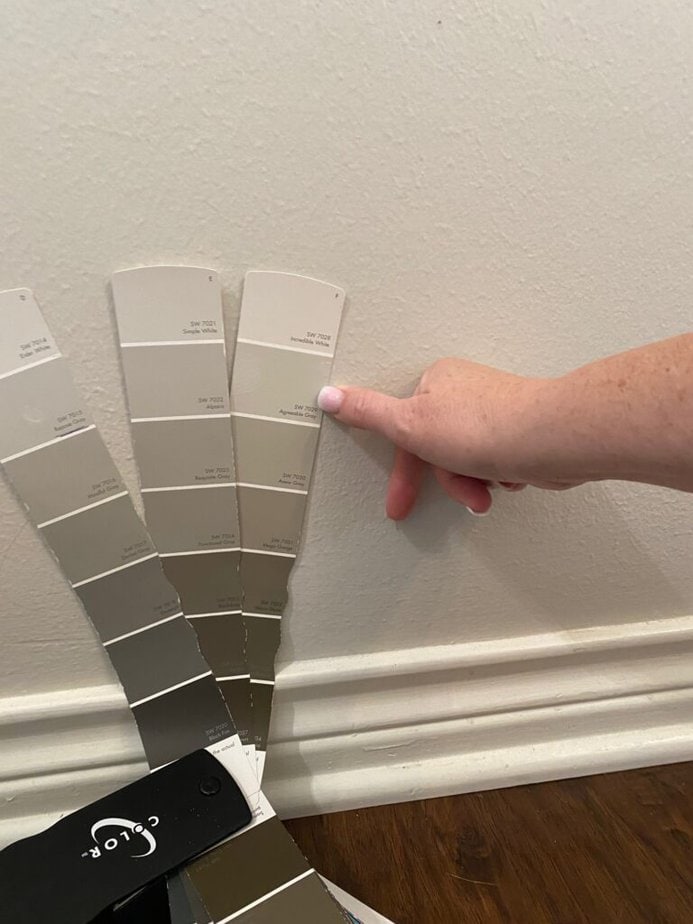
Paint swatch comparison works by holding or taping color chips directly against the wall in the area you want to match and observing them under different lighting conditions throughout the day. This method is most useful when you have a general sense of the color family and need to identify the closest match from available options. According to Benjamin Moore’s guide on touch-up and matching, always observe swatch comparisons under natural daylight, then under artificial lighting, because colors that look identical in one light condition often look different in another. Tape the candidate swatches flat against the wall rather than holding them, which reduces shadowing errors.
Swatch comparison alone is rarely precise enough for a touch-up that needs to be invisible, but it is a reliable method for selecting a new color when a full repaint of the wall is planned.
Can Home Depot Match Paint from a Picture? Can Lowes?
Yes, Home Depot and Lowe’s can both attempt to match paint from a picture, but photo-based matching is significantly less accurate than matching from a physical chip. Both stores use spectrophotometers at their paint counters, but those machines require a physical sample to measure. When presented with a phone photo instead, store staff compare the photo visually to their color libraries, which introduces human error and is affected by the photo’s lighting, screen brightness, and color calibration. According to the Cosmoquest discussion forum on paint matching tools, apps and photos are not reliable for matching existing paint on a wall because the colors in photos are rarely precise enough to reproduce a formula accurately.
For the best result at Home Depot, Lowe’s, or any paint retailer, bring a physical chip rather than a photo. A chip the size of a quarter from behind a switch plate will give the spectrophotometer a clean, accurate sample to work with. Both stores also allow you to bring in a chip from a competitor’s paint and attempt to match the formula into their own brand’s color system.
Can Sherwin-Williams Match Color from a Picture?
Sherwin-Williams can attempt to match color from a picture, but like other retailers, photo matching is far less reliable than chip matching. Sherwin-Williams stores have spectrophotometers and trained colorists who can cross-reference a photo against the brand’s library of over 1,700 available colors. However, for a precise match, the company’s own guidance recommends bringing a physical chip or the original paint can formula. The Sherwin-Williams ColorSnap app is designed to identify the closest color from a photo, but it works as a starting-point tool rather than a precision matching instrument.
Does Home Depot Color Match Paint for Free?
Yes, Home Depot color matches paint for free. The service of scanning a chip or sample and generating a formula match is provided at no charge at the paint counter. You pay only for the paint itself once the match is confirmed. Lowe’s also offers free color matching at their paint counters using the same process. Most independent paint stores and full-service retailers like Sherwin-Williams and Benjamin Moore offer free matching as well. The cost is built into the cost of the paint purchase rather than charged as a separate service fee.
Is Touch-Up Paint Noticeable?
Yes, touch-up paint is noticeable in most situations. Even when the color formula is exactly right, touch-up applications very often look different from the surrounding wall because of three factors that color alone cannot fix: paint fading on the existing wall, sheen build differences between the old and new paint, and application texture mismatch between the original coat and the touch-up method.
According to Just Add Paint, a professional painting resource, paint begins to fade almost immediately after application. Any paint on a wall for longer than six months will have faded slightly compared to fresh paint from the same can. The fading is uniform across the wall, which is why it is not noticed day to day, but a fresh spot of paint applied against the aged surface immediately reveals the color difference. This is true even when using the exact same can of paint from the original job.
According to Behr PRO’s guide on touch-up versus repaint, touch-up is an art form in the paint industry. The product team at Behr notes that the biggest failures in touch-up come from not applying enough paint, using the wrong applicator, not matching the sheen, and overworking the paint while it is still curing. Even professional painters with the right color and tools often find that a touch-up on a wall older than one year requires repainting the entire wall from corner to corner rather than spot-patching to achieve an invisible result.
What Is the Hardest Color to Paint Over?
The hardest color to paint over is a deep, saturated red. Red pigments have inherently low hide, meaning they require more coats than almost any other color to fully cover what is beneath them. This is true whether you are painting red over another color or painting any color over red. According to Sharper Impressions Painting, going from a dark color to a lighter one almost always requires a full primer coat to block the underlying color before the new finish coats are applied. Deep reds, navy blues, and dark greens are the most common colors that require this extra step. Attempting to cover a dark color with a lighter one in two coats without primer typically results in the underlying color bleeding through and altering the final appearance.
For touch-up matching specifically, dark and saturated colors are the most difficult because they show sheen variation more clearly than neutrals or light colors. According to Addicted 2 Decorating, dark flat-finish paints in particular will show a visible difference between a brushed touch-up and the original rolled coat, even when the color is identical. This is why dark, flat walls are considered the hardest to touch up invisibly in the residential painting world.
Why Is It So Hard to Match Paint?
It is so hard to match paint because achieving an invisible match requires four separate elements to align simultaneously: the color formula, the sheen level, the application texture, and the age of the paint on the wall. Getting the color right is only one quarter of the problem. Even a perfectly matched color will look wrong if the sheen level differs, if a brush was used on a rolled wall, or if the existing paint has faded while the touch-up paint is fresh.
According to New Life Painting, paint on a wall is 100% composed of dried solids after the water evaporates. As those solids are exposed to light, they gradually shift in tone. The shift is too slow to notice day to day but is immediately visible when fresh paint with full pigment saturation is placed next to it. This fundamental chemistry of how paint ages makes perfect touch-up matching essentially impossible in most real-world conditions. According to the DIY Chat Room forum, professional painters in the field routinely state that there is no such thing as touching up a wall without repainting the full section from natural break to natural break, meaning from corner to corner or from baseboard to ceiling.
What to Do If Your Touch-Up Paint Doesn’t Match
If your touch-up paint doesn’t match, the most reliable fix is to repaint the full wall from corner to corner rather than continuing to patch. This approach uses the natural breaks in the room, such as inside corners, door frames, and baseboard transitions, to hide any slight color difference between the repainted wall and adjacent surfaces. According to New Life Painting, repainting the wall from break to break minimizes total work while producing a result that looks uniform and intentional rather than patchy. When you repaint from corner to corner, minor color differences between the new paint and adjacent walls are hidden by the corners themselves rather than sitting in the middle of a flat surface where they catch light from every angle.
Before repainting the full wall, make sure the surface is clean, any repairs are primed and flush, and you are using the correct sheen level. Sheen is the element most often overlooked in touch-up work. According to Behr PRO, flat paints with flat, eggshell with eggshell, satin with satin. Mixing sheens on the same wall produces visible sheen inconsistencies that no amount of color matching can fix.
Proper interior painting done wall by wall with the correct preparation, sheen, and application technique is the only guaranteed way to achieve a result that is invisible after the work is done.
How to Touch Up Wall Paint Without It Showing
To touch up wall paint without it showing, clean the area, prime any repaired spots, use the same applicator that was used for the original coat, apply the paint as thinly as possible in the center of the repair and feather the edges outward, and assess the result under both natural and artificial light before deciding whether to repaint the full wall section.
According to Benjamin Moore’s touch-up technique guide, the two approved methods for blending touch-up paint are blending and feathering. Blending means starting with a small amount of paint at the center of the repair and rolling or brushing outward with decreasing pressure, so the new paint merges gradually into the old. Feathering means using a brush to extend light, thin strokes just past the edge of the repair area, creating a gradient that the eye cannot detect. Both techniques require applying less paint than you think you need and then evaluating fully dry results before adding more.
Applicator matching is critical. According to Crown Paints and the Addicted 2 Decorating resource, if the original wall was rolled, the touch-up must also be rolled. Using a brush on a rolled wall produces a different texture that catches light differently and is visible from an angle even when the color matches. Mini-rollers available at any hardware store allow rolling even very small repair areas. According to Behr PRO, applying the right roller nap thickness matters too. A roller with a different nap from the original will produce a different texture pattern even if the color and sheen are perfect.
The table below summarizes when touch-up paint is likely to work versus when repainting the full wall is the better choice.
| Situation | Touch-Up Likely to Work | Full Wall Repaint Recommended |
|---|---|---|
| Paint age | Less than 6 months old | More than 6 months, especially 1+ year |
| Finish level | Flat or matte paint | Eggshell, satin, semi-gloss, or gloss |
| Damage size | Small nick, nail hole, or tiny scuff | Large patch, multiple spots across same wall |
| Color | Light neutral or white | Dark, saturated, or strongly toned color |
| Original formula | Same can available with exact formula | Formula unknown, color matched from faded chip |
| Sun exposure | Interior wall away from direct sunlight | South or west-facing wall with heavy UV exposure |
Sources: Benjamin Moore Touch-Up and Matching Guide; Behr PRO Touch-Up vs. Repaint Reference; New Life Painting Touch-Up Chemistry Explainer; Just Add Paint Professional Painting Resource
Can I Use My Phone to Match a Paint Color?
Yes, you can use your phone to match a paint color using apps like Sherwin-Williams ColorSnap Visualizer, Benjamin Moore’s Color Portfolio, or third-party tools like Color Muse and Nix apps that pair with a physical sensor. Phone apps alone are convenient but not precise. They work best for identifying a color family and generating a shortlist of candidates to test, not for producing a formula precise enough to do an invisible touch-up on an existing wall.
For the most useful results when using a phone app, photograph the wall in an area with consistent, bright natural daylight. Avoid photographing under artificial light or in mixed lighting because the camera sensor will shift the color toward the dominant light source. Take several photos from different positions and use the one where the color appears most consistent across the wall surface. Then treat the app’s result as a starting point and verify by testing a sample on the actual wall before purchasing a full quart or gallon.
Is There an App That Can Tell Me the Color of Paint on My Wall?
Yes, there are apps that can tell you the color of paint on your wall. The most widely used are Sherwin-Williams ColorSnap Visualizer, which scans colors and matches them to Sherwin’s 1,700-plus color library, and Benjamin Moore’s Color Portfolio, which performs a similar function for Benjamin Moore’s range. Both are free and available on iOS and Android. The Nix Mini 2 Color Sensor, paired with the free Nix Toolkit app, is a hardware tool that pairs with a smartphone and gives more precise readings by pressing a calibrated sensor directly against the wall surface rather than relying on the phone camera. According to the CPIA, this type of handheld sensor achieves significantly better accuracy than camera-based apps alone.
Does Sherwin-Williams Have an App to Color Match?
Yes, Sherwin-Williams has an app called ColorSnap Visualizer for color matching. It allows users to photograph a wall or surface and match the color to the closest Sherwin-Williams paint. The app also includes an augmented reality feature called Instant Paint, which lets you preview any of Sherwin’s 1,700 colors on your walls in real time using your phone camera. According to the CPIA’s guide on paint matching tools, the ColorSnap app is one of the most popular and feature-rich consumer paint matching apps currently available. While it is a useful planning and identification tool, it should be used alongside a physical chip match at a Sherwin-Williams store for any touch-up work where an invisible result is the goal.
Can I Match the Color of Old Paint?
Yes, you can match the color of old paint, but you need to decide whether you want to match the faded current color or the original formula color. These are two different things, and which one you choose affects the touch-up result. If you bring a chip from a faded wall to the store for spectrophotometer matching, the machine will reproduce the faded color, which is what you see on the wall today. If you have the original formula from the can label, the store will mix the original color, which will look brighter and richer than the aged paint on the wall.
According to a painting resource from A Butterfly House, if you are doing a touch-up and the wall has faded, try thinning your touch-up paint very slightly with a single drop of water to reduce its color intensity and bring it closer to the faded wall tone. This trick can help reduce the visible contrast between a fresh touch-up and a faded surrounding surface when the only paint available is from the original formula.
For older walls where fading is significant and a touch-up will not blend invisibly regardless of the matching method, repainting the full wall from corner to corner is more efficient than continued patching attempts. A professional painter can complete a single wall repaint in a few hours, and the result is a uniform surface with no visible patches or sheen differences. For larger interior refresh projects in Lexington and the surrounding area, house painting services that cover full walls and rooms produce results that touch-up work never can.
Frequently Asked Questions
How Do I Find Out What Paint Color Is on My Walls in Lexington, SC?
To find out what paint color is on your walls in Lexington, SC, check behind outlet covers or switch plates for a protected paint sample and bring it to a local paint store for spectrophotometer matching. If you have the original paint can, the formula label on the lid tells you the exact color name and formula, which any paint store can remix. If neither is available, a Sherwin-Williams, Home Depot, or Lowe’s store in the Lexington and Columbia area can attempt a visual match from a chip. For the most accurate result, bring the cleanest, most protected chip you can find from behind a door or inside a closet where UV fading has not affected the color.
Why Does Touch-Up Paint Always Look Different in South Carolina Homes?
Touch-up paint looks different in South Carolina homes largely because of the state’s high UV intensity and warm climate. South-facing and west-facing walls in Lexington homes receive intense direct sunlight for much of the year, which accelerates paint fading faster than in northern states. According to Just Add Paint, any paint on a wall longer than six months will have faded enough to make fresh touch-up paint from the same can visually distinct. In South Carolina’s climate, this fading timeline can be even shorter on sun-exposed walls. The solution is to repaint the full wall from corner to corner rather than spot-patching walls that have been exposed to significant sunlight.
Can a Paint Store in Lexington Match Paint from a Chip?
Yes, paint stores in the Lexington and Columbia area can match paint from a chip using spectrophotometer technology. According to HowStuffWorks and House Beautiful, this process is typically about 90% accurate when the chip is clean and from a protected, unfaded area of the wall. Stores at Home Depot, Lowe’s, Sherwin-Williams, and Benjamin Moore retailers in the area all offer this service at no charge. For the best result, bring a chip from behind an outlet cover or switch plate where the original color is preserved and unaffected by surface dirt or UV fading.
Is It Better to Touch Up Paint or Repaint the Whole Wall?
It is better to repaint the whole wall when the paint is more than six months old, when the finish is eggshell or higher sheen, when the damage covers a large area, or when the original formula is unknown and the match is being made from a faded chip. According to Behr PRO, touch-up works well for flat paint, small damage, and recent paint jobs. For everything else, repainting the wall from corner to corner produces a cleaner, more consistent result. According to New Life Painting, even professional painters often find it faster and better-looking to repaint a full wall section rather than to attempt multiple rounds of increasingly visible touch-up patches.
How Do I Match Paint Color on Walls in an Older Lexington Home?
To match paint color on walls in an older Lexington home, take a chip from a protected spot such as inside a closet, behind a door, or behind an outlet cover and bring it to a paint store for spectrophotometer matching. For homes with significant sun exposure through the Midlands summers, expect that a formula match will look slightly brighter than the aged paint on the wall. The best approach for older homes is to treat the match as a starting point, test the matched color on the wall using a sample pot, and evaluate under both natural and artificial light before committing to a full can. If the result still does not blend invisibly, repainting the full wall from corner to corner is the professional approach.
What Is the Best App to Match Paint Color for Home Walls?
The best free apps to match paint color for home walls are Sherwin-Williams ColorSnap Visualizer and Benjamin Moore Color Portfolio. Both allow you to photograph a wall and identify the closest match within each brand’s color library. For more precise results, the Nix Mini 2 Color Sensor hardware paired with the Nix Toolkit app provides physical spectral readings from the wall surface rather than relying on a camera. According to the CPIA, the Nix Pro 2 achieves the highest accuracy among consumer-grade handheld tools, while the Sherwin-Williams ColorSnap device reports a 96% or higher match rate against its fan deck. For any touch-up work where an invisible result is needed, verify the app’s suggestion with a physical chip match at a paint store before purchasing full quantities.
When Should I Call a Painter Instead of Trying to Match Paint Myself?
Call a professional painter instead of trying to match paint yourself when the touch-up area is large, when the wall has significant fading and multiple patches are visible, when the finish is eggshell or satin (which are very difficult to touch up invisibly), or when previous DIY attempts have made the wall look worse rather than better. According to Behr PRO, touch-up is an art form, and professional painters who specialize in it have tools and techniques that make the difference between a seamless result and one that draws more attention to the problem. In Lexington, Red Bank, Chapin, and the surrounding Midlands area, a professional painter can assess whether a targeted touch-up or a full wall repaint is the right approach before any work begins.
Final Thoughts
Matching existing paint color on your walls comes down to using the right method for your situation. A saved paint can formula gives you a perfect batch reproduction. A clean chip from a protected wall area and a good spectrophotometer match gets you within 90% accuracy. Phone apps get you close enough to narrow down candidates. What the best color match in the world cannot fix is the gap between fresh paint and an aged, faded wall. That gap is a chemistry problem, not a color problem, and the only complete solution is repainting the full wall from corner to corner. Flat paints on recently painted walls are the exception. Everything else carries a meaningful risk that the touch-up will be more visible than the original damage.
If your walls in Lexington, South Carolina are showing their age and touch-up work is no longer giving you clean results, the team at Soda City Painting provides professional interior painting services across Lexington, Red Bank, Gilbert, Chapin, and the Lake Murray area. BBB accredited, licensed, and insured, they bring the tools, preparation, and technique to deliver walls that look like they were just painted, because they were. Contact them today for a free estimate and get your interior looking right again.